

Bombay HC orders CBI, ED probe into 44 Sinhgad society institutions
The Bombay High Court has directed the CBI, ED and Income Tax authorities to investigate 44 STES institutions over salary dues stated to exceed Rs 400 crore.
Key points
- The Bombay High Court on 10 November 2026 directed the CBI, ED and Income Tax authorities to investigate 44 STES institutions and their trustees.
- Unpaid salaries and retirement dues are stated in the order to exceed Rs 400 crore, and the court froze the society's and trustees' accounts.
- These are prima facie observations, not findings of guilt; a preliminary report from the agencies is due before the court on 19 November 2026.
The Enforcement Action
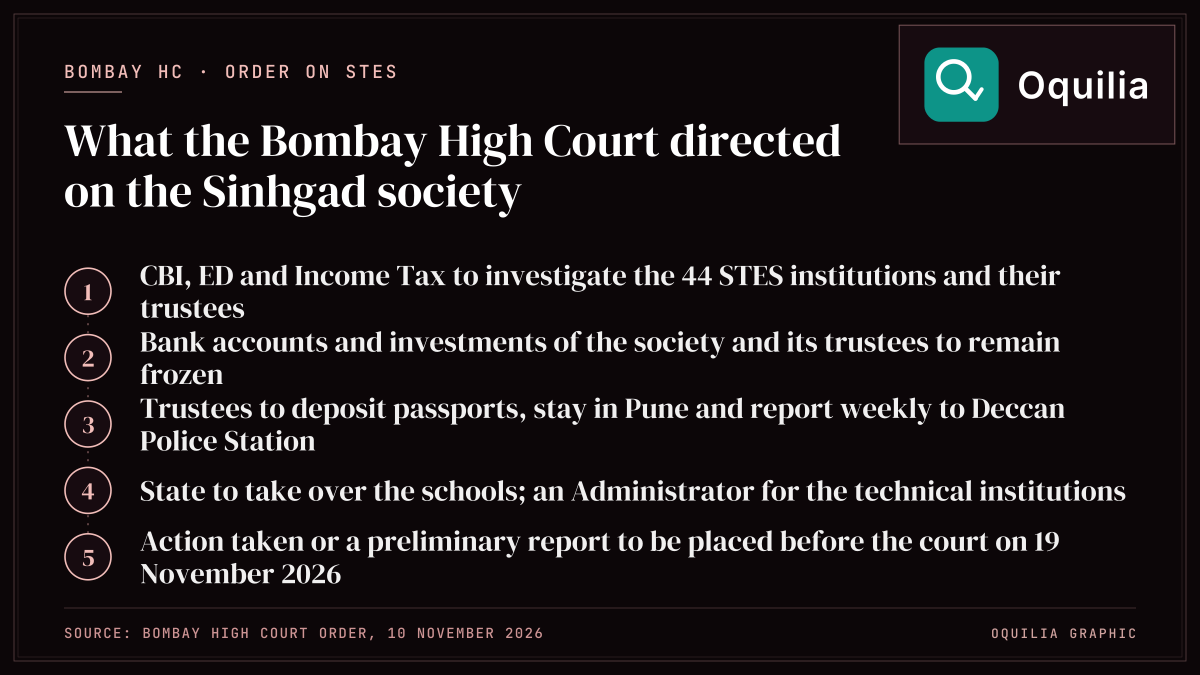
The Bombay High Court has directed the Central Bureau of Investigation (CBI), the Enforcement Directorate (ED) and the Income Tax authorities to investigate the affairs of 44 educational institutions run by the Sinhgad Technical Education Society (STES), Pune, and its trustees, according to the court's order dated 10 November 2026. The order was passed by a Special Bench of Justices G. S. Kulkarni and Advait M. Sethna in a batch of about 220 writ and contempt petitions, led by Contempt Petition No. 349 of 2026 in Writ Petition No. 6765 of 2018.
The petitions were filed by teaching and non-teaching employees of the 44 institutions over non-payment of salaries and retirement dues. Per the order, the outstanding amounts payable to employees "are stated to be more than Rupees 400 crores", and about 13 employees are stated to have died by suicide.
The court directed that the bank accounts and investments of the society and its trustees "shall remain freezed", barred the trustees from dealing with their shareholdings, ordered all trustees to deposit their passports, and issued contempt show-cause notices to the society and eight named trustees, including its President and Chief Managing Trustee, Maruti Nivrutti Navale. It asked for the action taken, or a preliminary report, to be placed before it on 19 November 2026.
These are directions to investigate, and the court's observations are expressly prima facie. No agency has yet filed any case under the order. The order records that new counsel for the society sought an adjournment, which the bench declined; it does not record any reply by the society or its trustees to the allegations.
How the Scheme Worked
The order sets out, in sequence, how the dispute reached this point. The salary grievance "is not new", the bench noted; petitions over unpaid dues have reached the High Court for several years and were bunched together before one Division Bench by order of the Chief Justice.
On 6 November 2026, according to the order, the Managing Trustee gave an assurance, recorded as an undertaking to the court, that Rs 60,65,06,436 would be released to the petitioners by that evening, and in any event by 7 November. Six letters dated 6 November addressed to the IDBI Bank, Nare Branch, Pune, were placed on record in support. On the strength of that undertaking, the court paused State orders de-recognising 13 schools and appointing an Administrator for the technical institutes.
At the 10 November hearing, the bench recorded that "no amounts whatsoever are paid" and described the six bank letters as "purportedly false". It found the undertaking had been breached and vacated the protection it had granted on 6 November.
The bench then turned to where the money had gone. It reasoned that 44 running institutions with full admissions, collecting fees from students other than those whose fees are subsidised by the State, could not plausibly default on salaries for almost eight years "unless the monies as gathered are diverted". The bench held that it had "a strong prima facie case" that amounts were being siphoned away, per the order. Having examined asset-disclosure affidavits filed by the trustees, it noted shareholdings in companies and co-operative banks, "huge" advances and what it called "shockingly disproportionate income tax returns", and said a possibility of money being moved out of the country "cannot be ruled out".
On that basis, the bench said there "appears to be a large-scale fraud on the part of the STES" and that the matter warranted investigation under the money laundering law. These are the court's prima facie observations, made before any investigation, and they are not findings after trial.
The Law Invoked
The Prevention of Money Laundering Act, 2002 (PMLA) is the law under which the court asked the ED to investigate whether the case "involves money laundering" by the Managing Trustee, the other trustees or the society. The PMLA lets the ED trace and attach the proceeds of crime and prosecute those it alleges dealt with them.
The Delhi Special Police Establishment Act, 1946, which the order cites as the statute governing the CBI's jurisdiction, is the basis for the CBI direction. Citing the Supreme Court's ruling in State of West Bengal vs. Committee for Protection of Democratic Rights, (2010) 5 SCC 571, the bench said such a direction must be made "as a matter of rarity" and that it was doing so because of the exceptional situation and to enforce the employees' fundamental rights under Articles 14 and 21 of the Constitution.
The order also invokes the Contempt of Courts Act read with Article 215 of the Constitution for the show-cause notices, the Maharashtra Educational Institutions (Management) Act, 1976 and the Maharashtra Educational Institutions (Transfer of Management) Act, 1971 for the State's takeover of institutions, and the Maharashtra Public Trusts Act, 1950 for an inquiry by the Charity Commissioner into the trust.
What Happens Next
The immediate next date is 19 November 2026, when the matter is listed before the Regular Bench and a preliminary report from the agencies is due. Separately, the Chief Commissioner of Income Tax in Pune is to examine the returns of the 44 institutions and the trustees, the Employees' Provident Fund authorities are to check the society's compliance with its statutory obligations to employees, and the Pune Police Commissioner is to report progress on FIRs already lodged.
In the meantime, the trustees must stay within Pune's jurisdiction, report weekly to the Deccan Police Station and hand over the society's records. The State Education Department is to take over the schools or move students elsewhere, and an Administrator is to take charge of the technical institutions.
If the CBI or the ED registers cases, those will follow their own procedure, from investigation to any chargesheet or prosecution complaint and then trial. A court-ordered investigation is not a finding of guilt. An investigation contains allegations, not findings of guilt; the accused are presumed innocent until proven guilty, and due process continues. The society may also seek to challenge the order before the Supreme Court.
What It Means
For the employees of the 44 institutions, the order is significant mainly for the asset freeze: by barring the trustees and the society from dealing with their accounts, investments and shares, the court is trying to keep money available for dues while investigators work. The State has already deposited Rs 27,77,94,288 in court under earlier directions, per the 6 November order quoted in the judgment, and that order said the court would hear the parties on how that money is to be released.
For salaried workers more broadly, the case is a reminder to watch for warning signs early. Check your EPF passbook on the EPFO member portal every few months to confirm that your employer is actually depositing contributions; a gap in deposits is often the first visible sign of trouble. Keep copies of appointment letters, salary slips and any written promises about arrears, since these are the documents that courts and labour authorities rely on.
The case also shows how unpaid-salary disputes can widen. What began as service petitions has, on the court's reading of the record, turned into a multi-agency investigation of where institutional fee income went. As the court's directions on de-recognition show, families paying fees to private institutions should check an institution's recognition status with the relevant State education directorate or university.
FAQ
Does this mean the people named are guilty?
No. The High Court has ordered an investigation and made prima facie observations; it has not convicted anyone. An investigation contains allegations, not findings of guilt; the accused are presumed innocent until proven guilty, and due process continues. The separate contempt notices require the society and its trustees to show cause, and they will be heard before any decision.
What exactly did the Bombay High Court order?
By its order of 10 November 2026, the court directed the CBI, the ED and the Income Tax authorities to investigate the 44 STES institutions and their trustees, froze the bank accounts and investments of the society and trustees, required the trustees to deposit their passports and report weekly to police, issued contempt show-cause notices, and directed the State to take over the institutions.
How much is owed to the employees?
According to the order, the outstanding salaries and terminal dues payable to the teaching and non-teaching staff are stated to be more than Rs 400 crore. The society had undertaken on 6 November 2026 to release Rs 60,65,06,436 as a first tranche, which the court recorded on 10 November had not been paid.
Can the order be challenged?
An order of a High Court can be challenged before the Supreme Court. The judgment does not refer to any appeal, and the matter remains listed before the Regular Bench of the Bombay High Court on 19 November 2026.
Where can I read the official order?
The order dated 10 November 2026 is available on Indian Kanoon, which reproduces the High Court's judgment. It lists all 44 institutions and the full text of the directions.
This report is based on the official Bombay High Court order dated 10 November 2026. It was surfaced via coverage in LiveLaw.
This report describes enforcement actions and allegations on the public record, attributed to the officials cited. An order, FIR or chargesheet is not a conviction; parties are presumed innocent until proven guilty.
Named in this report, or spotted an error? Corrections and responses: editor@oquilia.com. We correct errors promptly and record responses from named parties.