

Allahabad High Court quashes U.P. Gramin Bank pension recovery order on retiree
The Allahabad High Court quashed U.P. Gramin Bank's orders to recover money from a retired employee's pension, holding they gave no reasons and he was not heard.
Key points
- The Allahabad High Court quashed two U.P. Gramin Bank orders recovering an alleged excess payment from a retiree's pension.
- The court held on 25 November 2026 that the orders gave no reasons and the retiree was not heard before the recovery.
- The bank must decide afresh within two months after hearing him, and repay any amount owed within a month of that decision.
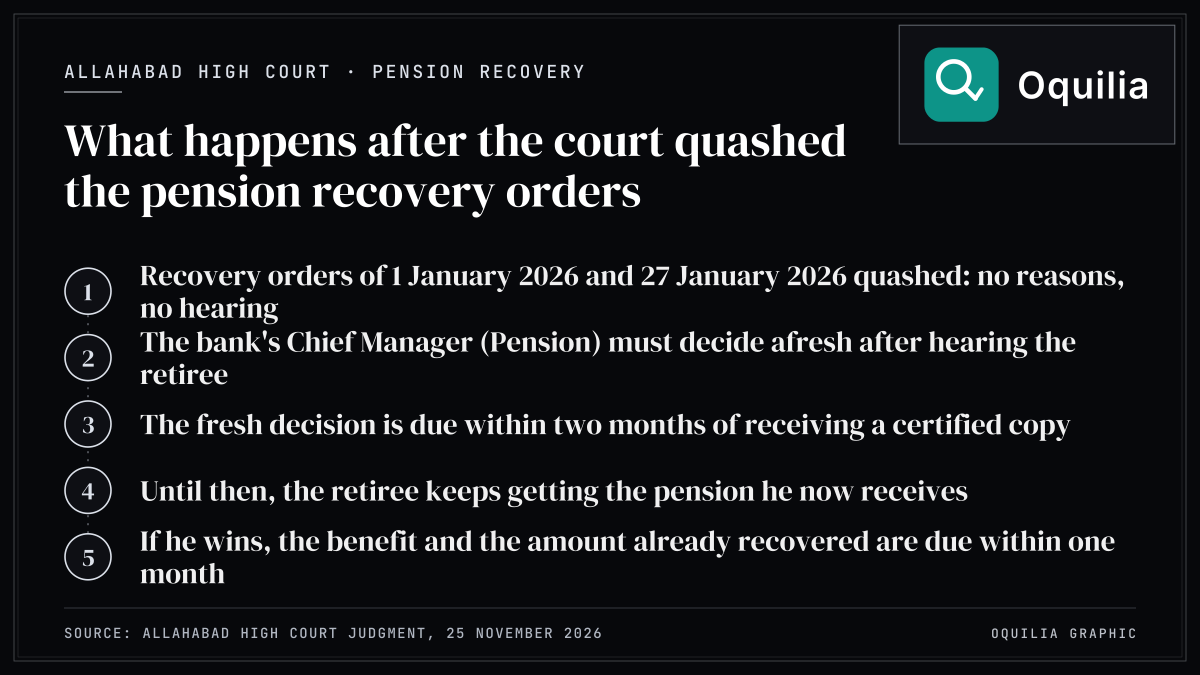
The Allahabad High Court, at its Lucknow bench, has quashed two orders of U.P. Gramin Bank that recovered an alleged excess payment from the pension of a retired employee. In a judgment delivered on 25 November 2026, the court held that the orders gave no reasons and that the retiree was not given a hearing before the recovery began.
What Happened
The retiree challenged a recovery order dated 1 January 2026, issued by the bank's Chief Manager (Pension) in Lucknow, and a second order dated 27 January 2026 that turned down his representation against it. He asked the court to set both aside, to order a refund with interest of the amounts already deducted from his monthly pension, and to restore his full pension.
The court held that both orders were "not speaking", meaning they did not set out reasons, although the law requires a reasoned order. It also held that no opportunity of hearing was given to the petitioner, a retired employee, before the first order was passed, and that in this case a hearing was required. The court decided the case without asking the bank for a counter affidavit and quashed both orders (Writ - A No. 12046 of 2026, neutral citation 2026:AHC-LKO:83729).
The Chief Manager (Pension) must now decide the matter afresh after hearing the retiree, considering the facts and the law, including the Supreme Court's judgments in State of Punjab v. Rafiq Masih (2015) 4 SCC 334 and Dr. M.K. Ravi Varma v. National Institute of Technology, 2026 INSC 1080. The decision is due within two months of the bank receiving a certified copy of the judgment. Until then, the retiree will keep getting the pension he now receives.
What It Means
For pensioners facing deductions over an alleged excess payment, the ruling holds that a bank cannot simply order a recovery: in this case it had to give reasons and hear the retiree first. If the fresh decision goes in the retiree's favour, the court ordered that the benefit, including repayment of the amount already recovered, be given within one month of that decision. The court allowed the writ petition. The judgment decides this retiree's case on its facts; the bank's fresh order is still to come.
Source: High Court judgment
Sources & Citations
- High Court judgment — Allahabad High Court