

Telangana High Court sets aside release of ED-attached Karvy assets to HDFC Bank
The Telangana High Court held that a special court wrongly let HDFC Bank recover ED-attached Karvy properties and shares before charges were framed in the money-laundering case.
Key points
- The Telangana High Court on 2 November 2026 set aside a special court order that released ED-attached Karvy properties and shares to HDFC Bank.
- HDFC Bank's two police complaints against Karvy Stock Broking and Karvy Comtrade involve Rs 329 crore and Rs 7.06 crore, according to the order.
- The court held that PMLA rules allow such a release only after charges are framed and other claimants are invited by newspaper notice.
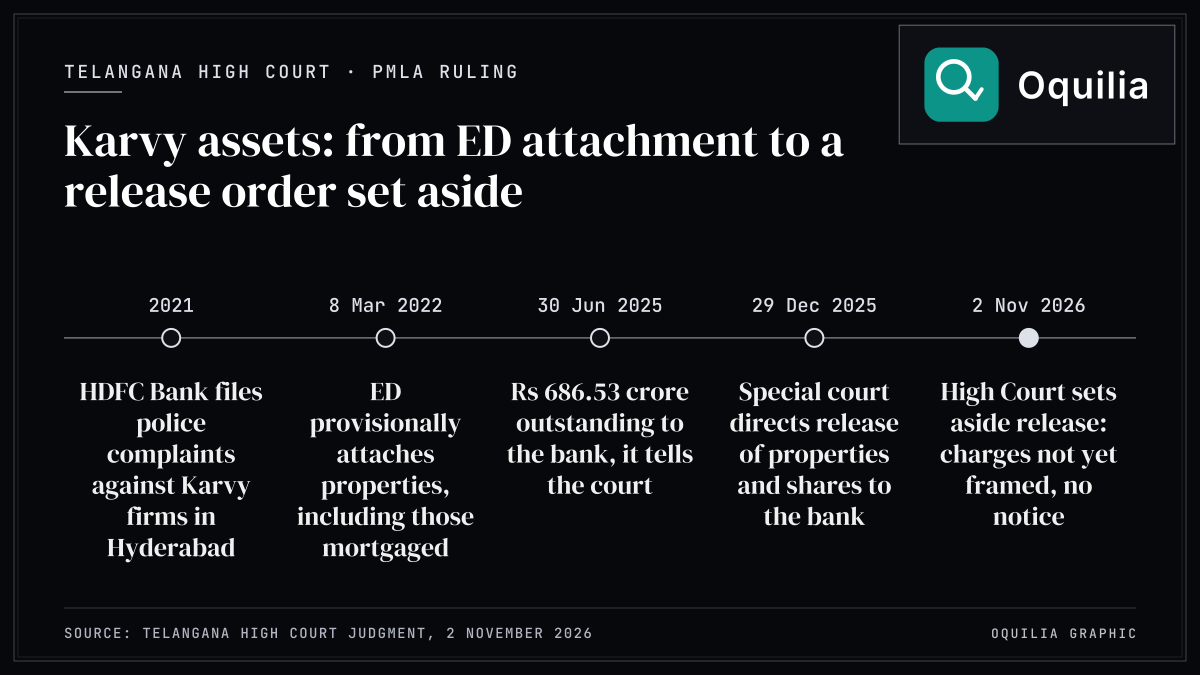
The Telangana High Court on 2 November 2026 set aside a Hyderabad special court order that had let HDFC Bank take back properties and KFin Technologies shares attached by the Enforcement Directorate (ED) in its money-laundering case against Karvy Stock Broking Limited. The court held that the release came too early, before charges were framed at trial.
What Happened
According to the order, HDFC Bank filed two police complaints in Hyderabad in 2021: one against Karvy Stock Broking and its directors, involving Rs 329 crore, and one against Karvy Comtrade and its directors, involving Rs 7.06 crore. The ED then began a case under the Prevention of Money Laundering Act (PMLA) and provisionally attached several properties on 8 March 2022, including properties mortgaged to the bank. The bank told the court that Rs 686.53 crore was outstanding as of 30 June 2025.
On 29 December 2025 the special court directed the ED to release the mortgaged properties and the pledged shares to HDFC Bank, which was to sell only enough to cover its dues and hand the rest back pending trial. Nine petitioners, including Karvy Stock Broking, challenged that order.
The High Court held that the PMLA and its 2016 restoration rules allow a court to return attached property during a trial only after charges are framed, and only after a notice in two newspapers, one in English and one in the local language, invites everyone with a claim to come forward. Charges had not been framed, and no notice was published. The court called the special court's order mechanical and set it aside. It also dismissed a separate application by a group of buyers who sought to join the case.
The ED's allegations are yet to be tested at trial. These are allegations, not findings of guilt; the accused are presumed innocent until proven guilty in court, and due process continues.
What It Means
The ruling sets out when a lender can recover property that the ED has attached. It must wait until charges are framed, and other claimants must get a public chance to be heard first. In this case the ED told the court that other banks, financial institutions and individuals also have claims on the attached assets, so the newspaper notice gives them a chance to put those claims to the court.
Source: High Court judgment
Sources & Citations
- High Court judgment — Telangana High Court