

SEBI seeks Rs 2.01 crore from former Mideast Integrated Steels CFO
SEBI's Recovery Officer has served a Rs 2.01 crore demand notice to recover a 2024 penalty over misstated Mideast Integrated Steels accounts, with interest.
Key points
- SEBI's Recovery Officer issued a Notice of Demand on 6 November 2026 to the former Joint MD and CFO of Mideast Integrated Steels Limited.
- The Rs 2.01 crore demand combines a Rs 1.5 crore penalty from SEBI's February 2024 order with Rs 51 lakh of interest, payable within 15 days.
- SEBI found in 2024 that the company misstated three years of accounts; unpaid dues can be recovered by attaching bank accounts and property.
The Enforcement Action
The Securities and Exchange Board of India (SEBI) has issued a Notice of Demand dated 6 November 2026 against Natasha Sinha, named in its records as the former Joint Managing Director and Chief Financial Officer of Mideast Integrated Steels Limited (MISL), seeking Rs 2,01,01,000 under Recovery Certificate No. 9321 of 2026. The notice was signed by SEBI's General Manager and Recovery Officer and published on the regulator's recovery proceedings page.
According to the certificate, the demand is made up of three parts: a penalty of Rs 1,50,00,000 imposed by SEBI's quasi-judicial authority, interest of Rs 51,00,000 for the period from February 2024 to November 2026 at 1% per month, and a recovery cost of Rs 1,000. The notice directs payment within 15 days of receipt.
The penalty traces back to a SEBI order dated 21 February 2024 (reference QJA/KS/CFID/CFID-SEC4/30037/2023-24), passed by Chief General Manager K. Saravanan. In that order, SEBI found that MISL had misrepresented its financial statements for the financial years 2018-19, 2019-20 and 2020-21, and held its then Joint MD and CFO, along with the company's chairperson and its chief executive, liable as officers in default.
Natasha Sinha has not publicly responded to the recovery notice, as far as the public record shows. In the original proceedings, the order records that the individual noticees told SEBI their submissions were in line with the replies filed by the company.
How the Scheme Worked
The matter began with complaints SEBI received in April and May 2021 alleging accounting manipulation, diversion of funds and the destruction of official records at MISL, a BSE-listed company whose shares the order describes as suspended for penal reasons. SEBI forwarded the complaints to BSE. According to the order, BSE reported in December 2021 that, despite around eight months of follow-ups, the company had not supplied documents to support its accounts.
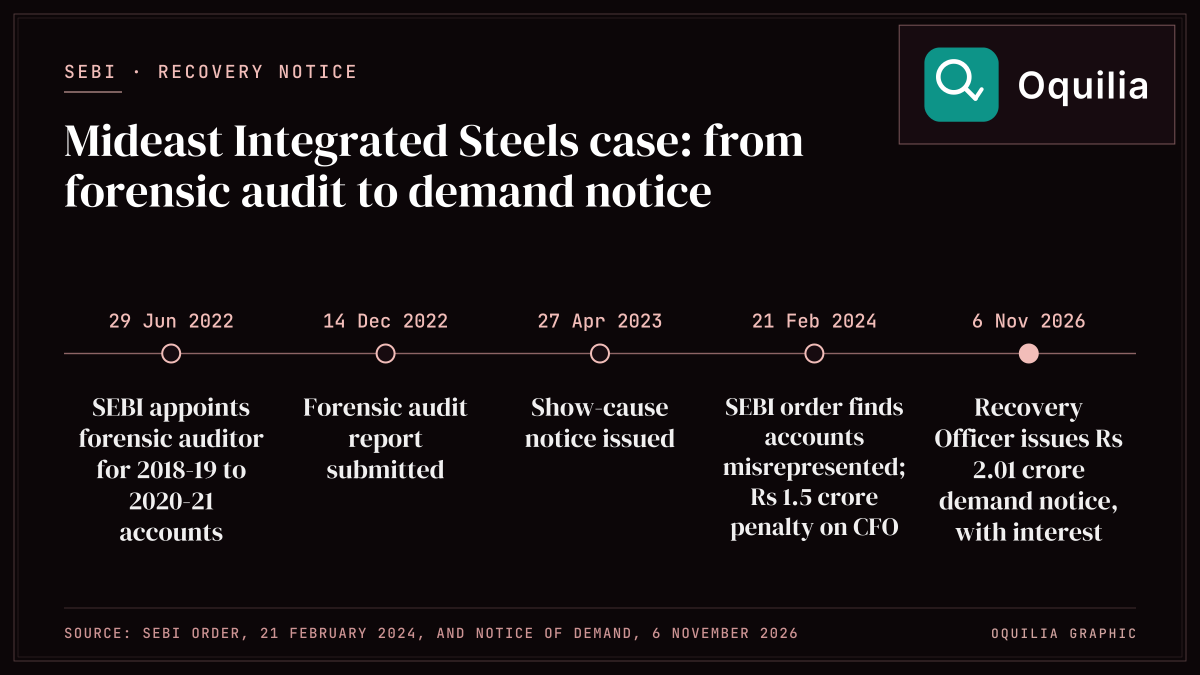
SEBI then opened an investigation under Section 11C of the SEBI Act and, on 29 June 2022, appointed a forensic auditor to examine the accounts for 2018-19 to 2020-21. The forensic audit report was submitted on 14 December 2022, a show-cause notice followed on 27 April 2023, and the final order came on 21 February 2024. The order also records that an insolvency process started against MISL by the National Company Law Tribunal in May 2023 was closed in November 2023 after the creditor withdrew.
The order's findings set out several distinct problems in the books, each attributed to the investigation:
- An unrecorded Rs 924.75 crore liability. The Supreme Court had, by an order dated 2 August 2017, imposed compensation of Rs 924.75 crore on MISL for iron ore mining beyond approved limits. SEBI found the company made no provision for it in any of the three years, despite remarks by its own auditors. The company told SEBI it had paid Rs 381.95 crore and treated the balance as a contingent liability; SEBI did not accept that treatment.
- Funds sent to group entities. SEBI found the company had for years advanced money to a related entity, Mesco Steels Ltd., for iron ore purchases that never took place, and that a substantial share was passed on to other group entities. The order found misutilisation of Rs 49.29 crore on the pretext of purchases from and sales to group companies, though it held a separate diversion allegation not established to the extent of Rs 122.62 crore.
- An investment carried at full value. MISL had put Rs 179.87 crore of equity into its subsidiary Maithan Ispat Ltd., whose net worth the investigation found had been completely eroded. SEBI held the company failed to make impairment provisions, overstating its assets.
- A Rs 38.71 crore write-back. SEBI found the company wrote back a disputed liability of that amount in 2019-20 without supporting evidence.
SEBI also found that MISL did not disclose GST inspection and seizure proceedings to the exchange and filed results late. The order states that the Joint MD and CFO signed the 2018-19 financials and, in a statement to SEBI, admitted that provisions for liabilities and impairment had not been made as the accounting standards required.
The Law Invoked
The 2024 order was passed under Sections 11(1), 11(4), 11(4A), 11B(1) and 11B(2) of the SEBI Act, 1992, which let SEBI issue protective directions, including market bans, and read with Sections 15A(a), 15HA and 15HB, the penalty provisions. Section 15HA penalises fraudulent and unfair trade practices with up to Rs 25 crore or three times the profit made, while Section 15HB is the general penalty for breaching SEBI rules where no specific penalty exists. On the former Joint MD and CFO, SEBI imposed Rs 1 crore under Section 15HA and Rs 50 lakh under Section 15HB.
The substantive breaches the order found included Regulations 4(1), 4(2)(f), 4(2)(k) and 4(2)(r) of the PFUTP Regulations, which bar misleading statements and manipulation of accounts, and Regulations 4(1), 33, 34(3) and 48 of the LODR Regulations, which govern the accuracy and timing of a listed company's disclosures.
The recovery notice itself rests on Section 28A of the SEBI Act, read with Sections 411 to 419 and 421 of the Income-tax Act, 2025, and Rule 225 of the Income-tax Rules, 2026. Section 28A lets SEBI's Recovery Officer collect unpaid penalties using the same machinery the tax department uses to recover arrears.
What Happens Next
If the dues are not paid within 15 days, the notice states that SEBI may recover them by attaching and selling movable or immovable property, attaching bank accounts, arrest and detention, or appointing a receiver. The notice also says that once it is served, the person may not mortgage, lease or otherwise deal with their property without the Recovery Officer's permission, and that some transfers to relatives made after 21 February 2024 without adequate consideration will be treated as the person's own assets. Copies went to CDSL, NSDL and all mutual funds, asking them to report holdings and any sale or redemption request.
Recovery notices are the collection stage, not a fresh finding. The underlying SEBI order could be appealed to the Securities Appellate Tribunal; the recovery notice does not refer to any appeal or stay. Penalties keep accruing interest at 1% per month until paid.
The order's two-year market ban and two-year bar on holding director or key managerial posts in listed companies ran from February 2024, so by its own terms that period has ended. The monetary penalty, however, remains due.
What It Means
For shareholders, the case shows how long the road is from a complaint to collection: complaints in 2021, a final order in 2024, and a demand notice in late 2026, with interest adding Rs 51 lakh to a Rs 1.5 crore penalty along the way. Penalties collected under SEBI orders go to the government, not to investors, so a recovery notice does not by itself compensate anyone who bought the stock.
The findings also point to warning signs retail investors can watch for in any listed company. Auditor qualifications in the annual report, large unsecured loans to promoter-group companies with no interest or repayment schedule, investments in loss-making subsidiaries carried at full value, repeatedly late results and a trading suspension are all flagged in this order. Each of these is visible in public filings on the BSE and NSE websites before a regulator acts.
Investors can check whether a company's shares are suspended on the exchange website, and can read SEBI's orders and recovery notices on its enforcement pages. Anyone with a grievance against a listed company can file it on SEBI's SCORES portal.
FAQ
Does this mean the people named are guilty?
SEBI's 2024 order is a regulator's civil finding with monetary penalties, not a criminal conviction, and the recovery notice lists arrest only as one possible collection mode. No FIR, chargesheet or criminal case forms part of this record. The order remains open to challenge under the law; anyone accused of a crime is presumed innocent until proven guilty, and due process continues.
What exactly has SEBI done now?
SEBI's Recovery Officer issued a Notice of Demand dated 6 November 2026 under Recovery Certificate No. 9321 of 2026, seeking Rs 2,01,01,000 from Natasha Sinha. The sum combines a Rs 1.5 crore penalty from SEBI's order of 21 February 2024, interest of Rs 51 lakh, and a Rs 1,000 recovery cost, payable within 15 days.
Does this notice mean SEBI has made new findings?
No. The notice enforces an existing penalty. The findings themselves are in the February 2024 order, where SEBI held that MISL misrepresented its financial statements for three years and that the company's senior officers were liable as officers in default. The recovery notice only moves to collect the unpaid sum.
Can the order be challenged?
SEBI orders of this kind can be appealed to the Securities Appellate Tribunal, and from there to the Supreme Court on questions of law. The recovery notice does not mention any appeal or stay. Until a tribunal or court sets the order aside, the penalty stands as SEBI ordered it.
What happens if the dues are not paid?
The notice lists the options open to the Recovery Officer: attachment and sale of movable and immovable property, attachment of bank accounts, arrest and detention, and appointment of a receiver. Depositories and mutual funds have already been asked to report any holdings.
Where can I read the official documents?
Both are on SEBI's website: the Notice of Demand under RC No. 9321 of 2026 and the order of 21 February 2024, which runs to 89 pages.
This report is based on the official SEBI Notice of Demand dated 6 November 2026 and the SEBI order dated 21 February 2024 in the matter of Mideast Integrated Steels Limited.
This report describes enforcement actions and allegations on the public record, attributed to the officials cited. An order, FIR or chargesheet is not a conviction; parties are presumed innocent until proven guilty.
Named in this report, or spotted an error? Corrections and responses: editor@oquilia.com. We correct errors promptly and record responses from named parties.