

SEBI issues Rs 10.31 lakh recovery notice to Investowryght Research
SEBI's Recovery Officer has demanded Rs 10.31 lakh from research analyst Investowryght Research Analytics over a Rs 10 lakh penalty for assuring returns and fee-cap breaches.
Key points
- SEBI's Recovery Officer issued a notice of demand on 6 November 2026 to Investowryght Research Analytics Private Limited under Recovery Certificate No. 9319 of 2026.
- The Rs 10,31,000 demand covers a Rs 10 lakh penalty imposed on 11 September 2026, plus Rs 30,000 interest and Rs 1,000 costs, payable within 15 days.
- SEBI found the research analyst's staff assured returns and induced clients to trade; the firm denied this, and unpaid dues can be recovered by attachment.
The Enforcement Action
The Securities and Exchange Board of India (SEBI) has moved to recover an unpaid penalty from Investowryght Research Analytics Private Limited, a research analyst registered with the regulator under registration number INH000012157. On 6 November 2026 SEBI's Recovery Officer issued a Notice of Demand under Recovery Certificate No. 9319 of 2026 against the company, certifying that Rs 10,31,000 is due to SEBI.
According to the notice, that sum is made up of a Rs 10,00,000 penalty imposed by a SEBI Adjudicating Officer, Rs 30,000 in interest for September to November 2026 at 1% a month, and Rs 1,000 in recovery costs. The company has been directed to pay within 15 days of receiving the notice.
The penalty itself comes from Adjudication Order No. Order/JS/YK/2026-27/32722 dated 11 September 2026. In that order, SEBI's Adjudicating Officer found that the firm's employees and executives had assured clients of returns and recovery of losses and induced them to trade, and that the firm had broken several research analyst compliance rules, including the annual fee cap.
In its reply to the show-cause notice, the company denied ever assuring or guaranteeing returns to the clients concerned, denied any profit-sharing arrangement and denied obtaining or misusing any client's banking credentials or OTP. The order records that the company did not appear at the hearing on 9 September 2026. No public response to the recovery notice is on record.
How the Scheme Worked
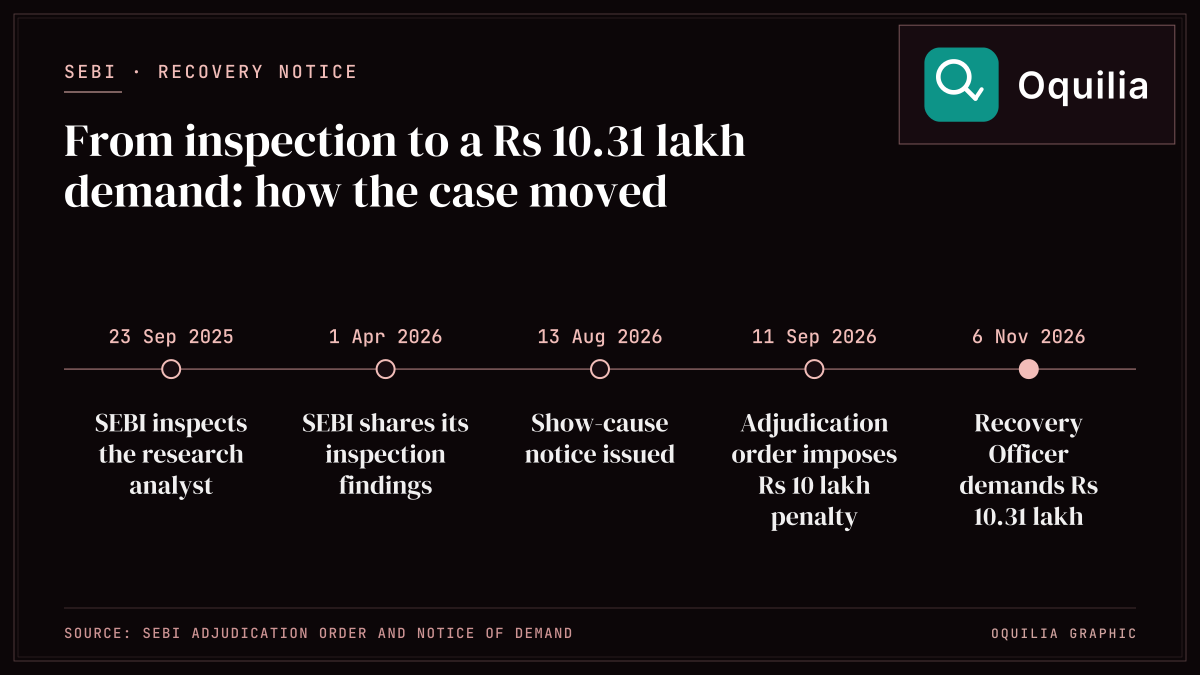
The matter began with a routine supervisory step. According to the order, SEBI inspected the firm on 23 September 2025, covering the period from 1 April 2024 to 31 August 2025. SEBI shared its findings on 1 April 2026, the company replied by email on 13 and 27 April 2026, an Adjudicating Officer was appointed on 12 August 2026, and a show-cause notice dated 13 August 2026 followed. The company filed a reply on 27 August 2026.
The central finding concerns two investor complaints filed on SEBI's SCORES grievance portal, whose complainants the order does not name. For the first complainant, the order says WhatsApp chat screenshots showed the firm's representative issuing trade-specific instructions to buy set numbers of lots, asking for screenshots after execution and repeatedly urging the client to "arrange" and "add" more funds after losses. The order quotes messages such as "recover ho jyega sir" and "Profit deke jyega", and records the client writing that he had been promised daily returns on his investment.
For the second complainant, the order says WhatsApp numbers linked to the firm sent investment tips, asked him to pay Rs 2 lakh which he understood would be invested in the market for him, and pushed him to take positions in large quantities. The amount was later invoiced as service charges. The company told SEBI that this client lodged a cyber complaint, its bank account was frozen, and it refunded the money as a bona fide step and not as an admission of wrongdoing.
The Adjudicating Officer held that generic risk disclaimers in onboarding papers "cannot neutralize contrary conduct" by staff, and found that the inducement had been established. On profit-sharing, however, the officer gave the firm the benefit of the doubt, finding no clear message in the record demanding a fixed share of profits. The order also notes that claims about misuse of banking details did not fall for decision in these proceedings.
Separately, the order found that nine clients paid fees above the Rs 1,51,000 annual cap after SEBI's circular of 8 January 2025 setting the cap, collecting about Rs 6 lakh in excess fees in all, and that plans priced above the cap were still listed on the firm's website. It also found that client KYC was not collected in the uniform CKYCR format, that complaint data had been published only up to July 2025 as of 1 April 2026, and that half-yearly reports to the research analyst supervisory body (RAASB) for the periods ended 31 March 2025 and 30 September 2025 had not been filed on time.
The Law Invoked
On the inducement finding, the order holds that the firm violated regulations 3(a), 3(b), 3(d), 4(1), 4(2)(k), 4(2)(o) and 4(2)(s) of the SEBI (Prohibition of Fraudulent and Unfair Trade Practices relating to Securities Market) Regulations, 2003, read with sections 12A(a), (b) and (c) of the SEBI Act, 1992, and clauses 1, 2, 7 and 8 of the research analyst Code of Conduct. In plain terms, these provisions bar deceptive devices in securities dealings, spreading misleading advice that is likely to influence investors, inducing someone to trade to increase one's own income, and mis-selling securities services. The order treated advice designed to influence client trades as "dealing in securities".
The compliance findings rest on regulations 15A (fees), 24(2) and 24(4) (code of conduct and periodic reporting) and 25(1)(v) (records) of the SEBI (Research Analysts) Regulations, 2014, read with clauses of SEBI's Master Circular dated 6 February 2026.
The penalties were imposed under section 15HA of the SEBI Act, which sets a floor of Rs 5 lakh for fraudulent and unfair trade practices, and section 15EB, which covers defaults by research analysts. The recovery notice is issued under section 28A of the SEBI Act read with section 413 of the Income-tax Act, 2025 and Rule 225 of the Income-tax Rules, 2026.
What Happens Next
The notice sets out the steps SEBI may take if the dues are not paid within 15 days: attachment and sale of movable property, attachment of bank accounts, attachment and sale of immovable property, arrest and detention, and the appointment of a receiver. It also states that from the date of service the company may not mortgage, lease or otherwise deal with its property without the Recovery Officer's permission, and that some transfers of property to relatives made on or after 11 September 2026 will be treated as the company's own property for recovery purposes.
Copies have gone to the depositories CDSL and NSDL and to all mutual funds, asking them to report the company's holdings and to alert the Recovery Officer to any sale or redemption request.
The underlying adjudication order is a regulator's finding, not a court judgment. An order of a SEBI Adjudicating Officer can be appealed to the Securities Appellate Tribunal, and from there to the Supreme Court on questions of law. No appeal against this order is shown on the public record reviewed for this report. The adjudication order records the company's position that it did not assure returns, and those submissions form part of the record any appeal would consider.
What It Means
For retail investors, the order describes a familiar pattern: a registered entity whose staff, according to SEBI's findings, moved beyond research into hands-on trade calls on WhatsApp, pressed clients to add money after losses and promised recovery. SEBI's reasoning is worth noting. A registration number and a risk disclaimer on a website do not make later assurances acceptable, and the regulator looks at what was actually said in client chats.
There are practical checks any investor can run. A genuine research analyst's registration can be verified on SEBI's website under its list of registered intermediaries. No SEBI-registered research analyst may promise assured returns or recovery of losses. Fees for individual and HUF clients are capped at Rs 1,51,000 a year per family, and a plan priced above that is a warning sign. A research analyst also should not be asking you to transfer money "for investment" into its own account.
If you have dealt with an adviser or analyst who behaved this way, keep the chats and payment records and file a complaint on SCORES, SEBI's grievance portal. For suspected cyber fraud, the national cybercrime helpline 1930 and cybercrime.gov.in are the right channels. Penalties recovered by SEBI go to the regulator, not to individual investors, so a complaint and any civil remedy remain separate routes.
FAQ
What exactly did SEBI order?
SEBI's Adjudicating Officer imposed a total penalty of Rs 10 lakh on Investowryght Research Analytics Private Limited by order dated 11 September 2026: Rs 5 lakh under section 15HA and Rs 5 lakh under section 15EB of the SEBI Act. The penalty was payable within 45 days. On 6 November 2026 SEBI's Recovery Officer issued a notice of demand for Rs 10,31,000, including interest and costs.
Does this mean the firm committed a crime?
No criminal court has convicted anyone in this matter. This is a civil regulatory finding by SEBI's Adjudicating Officer under the SEBI Act. The firm has denied assuring returns and denied any profit-sharing arrangement. The order can be challenged before the Securities Appellate Tribunal, and its findings stand as the regulator's conclusions unless they are set aside.
Can the order be appealed?
Yes. Orders of SEBI Adjudicating Officers can be appealed to the Securities Appellate Tribunal (SAT) in Mumbai, and SAT's decisions can be taken to the Supreme Court on questions of law. No appeal in this matter is shown in the public record reviewed for this report.
How can I check whether a research analyst is registered?
Use the "Recognised Intermediaries" section on SEBI's website and search the list of research analysts by name or registration number, which begins with INH. Then check that the number on the firm's website, invoices and messages matches the entity you are paying. Payments should go only to the registered entity's own bank account.
What should affected clients do?
Keep every chat, call record, invoice and bank statement. File a complaint on SEBI's SCORES portal against the registered entity, and, where you suspect cyber fraud, report it on 1930 or cybercrime.gov.in. SEBI's penalty does not automatically return money to clients, so consider legal advice on separate remedies.
Where can I read the official documents?
Both are on SEBI's website: the adjudication order dated 11 September 2026 under Enforcement, Orders of AO, and the notice of demand dated 6 November 2026 under Enforcement, Recovery Proceedings. Both are linked in this report.
This report is based on the official SEBI Notice of Demand under Recovery Certificate No. 9319 of 2026 dated 6 November 2026 and the SEBI adjudication order dated 11 September 2026, both published by SEBI.
This report describes enforcement actions and allegations on the public record, attributed to the officials cited. An order, FIR or chargesheet is not a conviction; parties are presumed innocent until proven guilty.
Named in this report, or spotted an error? Corrections and responses: editor@oquilia.com. We correct errors promptly and record responses from named parties.