

SEBI recovers Rs 10.41 lakh in Moksh Ornaments Telegram tips case
SEBI closed recovery against Aviral Saxena after he paid Rs 10.41 lakh, a penalty from its July 2026 order on paid Telegram buy tips in Moksh Ornaments shares.
Key points
- SEBI's Recovery Officer closed Recovery Certificate No. 9303 of 2026 against Aviral Saxena after he paid the amount due.
- The Rs 10,41,000 recovered relates to a Rs 10 lakh penalty SEBI imposed on 30 July 2026 over paid Telegram tips in Moksh Ornaments.
- Investors should check SEBI registration before acting on stock tips, as the order found these posts were coordinated and paid for.
The Enforcement Action
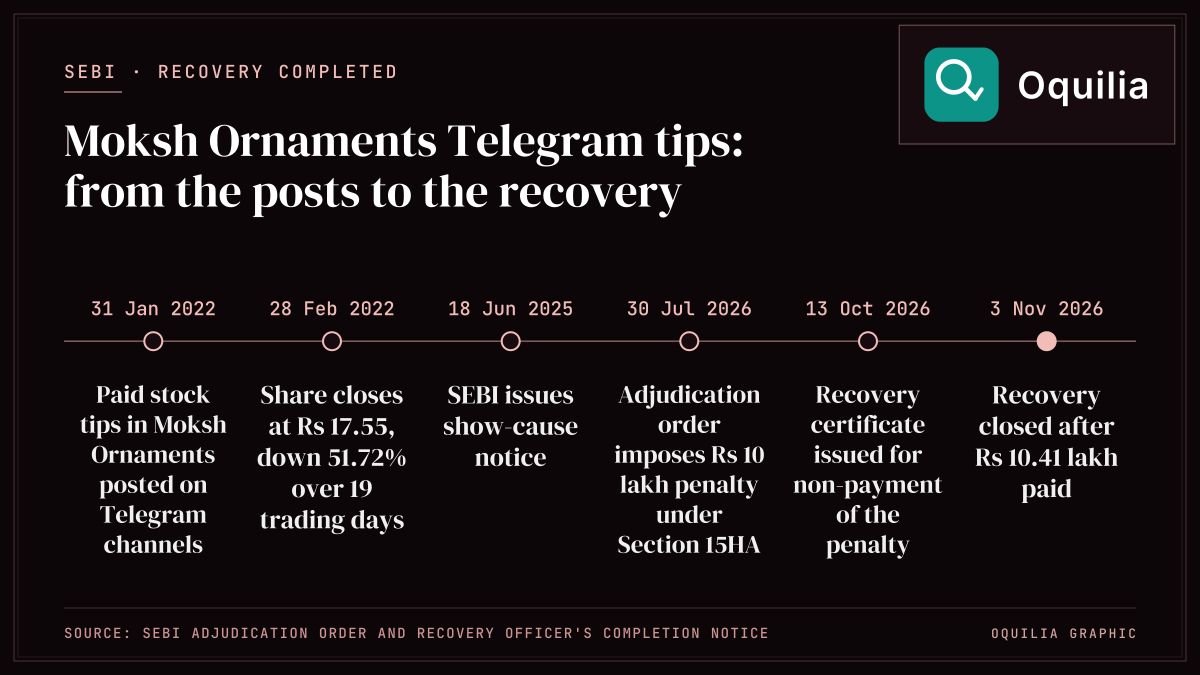
The Securities and Exchange Board of India (SEBI) has closed recovery proceedings against Aviral Saxena (PAN: KVYPS1652D) after he paid Rs 10,41,000 due under Recovery Certificate No. 9303 of 2026, according to a completion notice issued by SEBI's Recovery Officer at SEBI's Northern Regional Office in New Delhi on 3 November 2026.
The certificate, dated 13 October 2026, was drawn for "non-payment of penalty imposed by Adjudicating Officer", the notice states. That penalty came from Adjudication Order No. Order/JS/YK/2026-27/32530-32542 dated 30 July 2026, issued in the matter of market manipulation using social media in the scrip of Moksh Ornaments Limited, a company listed on the National Stock Exchange (NSE).
In that order, SEBI's Adjudicating Officer imposed a penalty of Rs 10,00,000 on Mr Saxena under Section 15HA of the SEBI Act. The Rs 10,41,000 recovered covers that sum plus interest and costs, which a recovery certificate allows SEBI to collect. With payment made, the Recovery Officer declared the certificate completed under Section 28A(1) of the SEBI Act read with Rule 12 of the Second Schedule to the Income-tax Act, 1961.
The same order penalised three other people and cleared nine other noticees, including the person SEBI's show-cause notice had alleged was the main perpetrator. During the proceedings, Mr Saxena contested the allegations. He argued that his role was limited to posting messages forwarded to him and that he never traded in the stock. The order records and rejects those submissions. He has not publicly responded to the recovery notice.
How the Scheme Worked
According to the order, SEBI was investigating several stocks in which tips were circulated on Telegram channels. During search and seizure operations, it seized the digital device of Jalaj Agrawal, whom the order describes as a middleman or operator. The data extracted from that device led SEBI to the Moksh Ornaments messages posted on 31 January 2022 and 1 February 2022. The investigation covered the period from 31 May 2021 to 31 March 2022.
The order sets out a chain. It held that Amesh Surajlal Jaiswal sent buy recommendations in the stock to Mr Agrawal, who forwarded them to Arvind Shukla and Mr Saxena for posting on their Telegram channels. The WhatsApp messages recovered from the device contained an entry price, a stop loss, a buy quantity and target prices. The order says they were sent "with the claim of at least 40-50% return in 5-7 days".
In statements recorded on oath in February 2025, which the order quotes, Mr Saxena said he ran three stock-tip Telegram channels with about 5,000 to 7,000 active subscribers and 1.5 to 2 lakh total subscribers each. He said he was paid Rs 25,000 a day in cash to post recommendations, receiving about Rs 18 to 20 lakh between November 2021 and March 2022 across various stocks. He also said he had been told to delete the posts by the end of the day. Call data records showed 12 calls between Mr Agrawal and Mr Saxena on 31 January 2022, the order notes.
The order's price data shows what happened next. The closing price rose about 9.09% over the two recommendation days, from Rs 33.30 on 28 January 2022 to Rs 36.35 on 1 February. The number of trades rose more than five times on both days. From 2 February, the price fell steadily and closed at Rs 17.55 on 28 February 2022, a decline of 51.72% over 19 trading days. The number of public shareholders rose from 11,229 on 28 January to 22,248 on 4 February 2022.
SEBI appointed the Adjudicating Officer on 16 May 2025 and issued a show-cause notice dated 18 June 2025. Mr Saxena replied through his authorised representatives in July and September 2025 and was cross-examined on 7 January 2026. At the adjudication stage, the three men whose statements had been recorded retracted them, saying they were made under coercion. The officer held that claim to be "an afterthought and is not credible".
The Law Invoked
The order found that the four penalised people violated Sections 12A(a), (b) and (c) of the SEBI Act, 1992. These sections prohibit using manipulative or deceptive devices, and engaging in any act or practice that operates as a fraud, in connection with dealing in securities. It also found violations of Regulations 3(a), (b), (c), (d), 4(1), 4(2)(a), 4(2)(k) and 4(2)(r) of the SEBI (Prohibition of Fraudulent and Unfair Trade Practices relating to Securities Market) Regulations, 2003. These regulations cover fraudulent dealing, acts that create a false or misleading appearance of trading, spreading misleading information that influences investors, and planting false or misleading news to induce people to buy or sell securities.
The penalty was imposed under Section 15HA of the SEBI Act, which provides for a penalty of at least Rs 5 lakh and up to Rs 25 crore or three times the profits made, whichever is higher. Mr Jaiswal was also penalised under Section 15HB for failing to appear before the investigating authority as required by Section 11C(5). In fixing the amounts, the officer applied the Section 15J factors: disproportionate gain, loss to investors and repetition. The officer noted that the record did not quantify either the gain or the loss.
Recovery was enforced under Section 28A of the SEBI Act. This section lets SEBI recover unpaid dues in the way the Income-tax Act provides, including by attaching bank accounts and property.
What Happens Next
For Mr Saxena, the recovery file is now closed: the completion notice confirms the amount due under the certificate has been paid. The adjudication order itself remains a regulator's finding. Like any SEBI adjudication order, it can be appealed to the Securities Appellate Tribunal (SAT), and SAT decisions can be appealed further to the Supreme Court on questions of law.
The order imposed Rs 20 lakh on Mr Jaiswal (Rs 15 lakh under Section 15HA and Rs 5 lakh under Section 15HB), Rs 15 lakh on Mr Agrawal and Rs 10 lakh on Mr Shukla. It gave all four 45 days to pay. If they did not, it warned that SEBI may start recovery proceedings under Section 28A, including attaching and selling movable and immovable property. The order notes that Mr Agrawal had earlier gone to the SAT during the proceedings (Appeal No. 420 of 2025), which on 25 September 2025 directed SEBI to provide the investigation report and allowed him to seek cross-examination.
The proceedings against the other nine noticees were disposed of without any penalty. The officer found that their trading pattern did not support the allegation that they sold their holdings because of the Telegram messages.
What It Means
The order spells out why paid stock tips are treated as deception, not simply bad advice. It reasons that readers seeing the same call across several channels "would believe that they reflected independent market analysis", when in fact the posts were coordinated and paid for. The breach it identifies is in hiding where the tip came from, as much as in what the tip said.
For ordinary investors, the price table is the practical lesson. Readers who bought on 31 January or 1 February 2022 at around Rs 36 saw the stock close at Rs 17.55 within four weeks. Typical warning signs in the order include a specific promised return over a short window ("40-50% return in 5-7 days"), exact entry and exit prices, posts that disappear by the end of the day, and the same tip turning up on many channels at once.
Before acting on any stock recommendation, check whether the person giving it is registered with SEBI as an investment adviser or research analyst. You can do this on SEBI's website under "Recognised Intermediaries". Complaints about unregistered advice can be filed on SEBI's SCORES portal.
FAQ
What exactly did SEBI order against Aviral Saxena?
In its adjudication order dated 30 July 2026, SEBI's Adjudicating Officer imposed a penalty of Rs 10,00,000 under Section 15HA of the SEBI Act. The officer found that he and three others had colluded in posting misleading buy recommendations in Moksh Ornaments Limited on Telegram channels on 31 January and 1 February 2022. When the penalty was not paid, Recovery Certificate No. 9303 of 2026 was issued. It has now been completed after payment of Rs 10,41,000.
Is this a criminal conviction?
No. This is a civil adjudication by a regulator, not a criminal conviction. The order records SEBI's findings under the SEBI Act and the PFUTP Regulations on the civil standard of preponderance of probabilities, which it notes is the test in these proceedings. SEBI orders can be appealed to the Securities Appellate Tribunal. Nine of the thirteen noticees were cleared without any penalty.
Can the order be appealed?
Yes. Orders passed by a SEBI Adjudicating Officer can be challenged before the Securities Appellate Tribunal, and SAT rulings can be appealed further to the Supreme Court.
How can I check if a stock tip comes from a registered adviser?
SEBI publishes lists of registered investment advisers and research analysts under "Recognised Intermediaries" on sebi.gov.in. An anonymous Telegram channel promising fixed short-term returns is a well-documented warning sign.
Where can I read the official order?
The full 85-page adjudication order and the recovery completion notice are both published in the enforcement section of SEBI's website. Links to both are at the end of this report.
This report is based on SEBI's completion notice for Recovery Certificate No. 9303 of 2026 dated 3 November 2026, and on the official SEBI adjudication order dated 30 July 2026 in the Moksh Ornaments Limited matter.
This report describes enforcement actions and allegations on the public record, attributed to the officials cited. An order, FIR or chargesheet is not a conviction; parties are presumed innocent until proven guilty.
Named in this report, or spotted an error? Corrections and responses: editor@oquilia.com. We correct errors promptly and record responses from named parties.
Sources & Citations
- Completion of Recovery Certificate No. 9303 of 2026 issued to Mr. Aviral Saxena in the matter of market manipulation using social media in the scrip of Moksh Ornaments Limited — SEBI
- Adjudication Order in the matter of market manipulation using social media in the scrip of Moksh Ornaments Limited — SEBI