

SEBI attaches bank accounts to recover Teledata GDR case penalty
SEBI has ordered banks and post offices to attach a former Teledata director's accounts to recover Rs 11.31 lakh due under a 2022 penalty in the GDR issue matter.
Key points
- SEBI's Chennai Recovery Officer ordered all banks and post offices on 10 November 2026 to attach a former Teledata Technology Solutions director's accounts.
- The notice seeks Rs 11,31,000 under Recovery Certificate No. 6735 of 2023, made up of a Rs 10 lakh penalty, Rs 1.3 lakh interest and Rs 1,000 costs.
- The penalty stems from a May 2022 SEBI order that found Teledata's 2010 GDR issue fraudulent; unpaid SEBI penalties are recovered like tax arrears.
The Enforcement Action
The Securities and Exchange Board of India (SEBI) has ordered banks and post offices across the country to attach the accounts of R Ravichandran, a former director of Teledata Technology Solutions Ltd, to recover an unpaid penalty of Rs 10 lakh plus interest and costs. The notice of attachment is dated 10 November 2026 and was issued by the Recovery Officer at SEBI's Southern Regional Office in Chennai.
The notice is issued under Attachment Proceeding No. 13512 of 2025 and relates to Recovery Certificate No. 6735 of 2023, dated 27 June 2023. According to the notice, the total sum due is Rs 11,31,000: the penalty of Rs 10,00,000, interest of Rs 1,30,000 calculated at 1% per month from June 2022 to June 2023, and a recovery cost of Rs 1,000. A Notice of Demand was issued on the same day as the certificate, and the notice records that "no amount has been paid by the defaulter".
The penalty itself was imposed by a SEBI adjudicating officer in Adjudication Order No. Order/SM/AD/2022-23/16841-16848, dated 31 May 2022, in the matter of the Global Depository Receipt (GDR) issue of Teledata. That order penalised the company and six individuals over a 2010 GDR issue that SEBI found to be fraudulent.
SEBI lists the 2022 order among orders that could not be served on Mr Ravichandran. The order records that he did not attend the personal hearings offered to him. He has not publicly responded to the attachment notice.
How the Scheme Worked
According to the 2022 adjudication order, SEBI investigated the GDR issue made by Teledata, a company listed on the BSE and NSE, between 1 February 2010 and 31 March 2010. The order records that Teledata issued 3.5 million GDRs worth US$36.96 million on 12 March 2010, and that the whole issue was subscribed by a single entity, Vintage FZE (now Alta Vista International FZE).
The order found that Vintage paid for the GDRs with a loan from European American Investment Bank AG, Austria (EURAM Bank) under a loan agreement dated 26 February 2010. At a Teledata board meeting on 30 January 2010, the directors passed a resolution to open an account with EURAM Bank to receive the subscription money. Under a pledge agreement signed on the same day as the loan, Teledata pledged the GDR proceeds as collateral for Vintage's loan. In the order's words, Vintage "acquired the GDRs without spending a penny".
Vintage repaid only US$4.6 million of the loan, the order records, and EURAM Bank recovered the shortfall of US$32.53 million from Teledata's pledged proceeds. The order therefore found that GDRs worth US$32.53 million were issued without consideration, a loss to Teledata's shareholders, whose holdings were diluted by the enlarged equity.
The adjudicating officer also found that 23,20,000 GDRs were transferred to a foreign institutional investor sub-account connected to the person who structured the issue. That account converted them into 23,20,00,000 Teledata shares and sold them on Indian exchanges for Rs 31.57 crore.
On disclosure, the order found that Teledata did not tell the stock exchanges about the pledge and filed a wrong list of GDR subscribers with the BSE. It also showed the pledged sums of Rs 169.82 crore (31 March 2010) and Rs 148.56 crore (31 March 2011) as free cash, without disclosing a contingent liability. The order found that this gave investors the impression the GDRs had been genuinely subscribed.
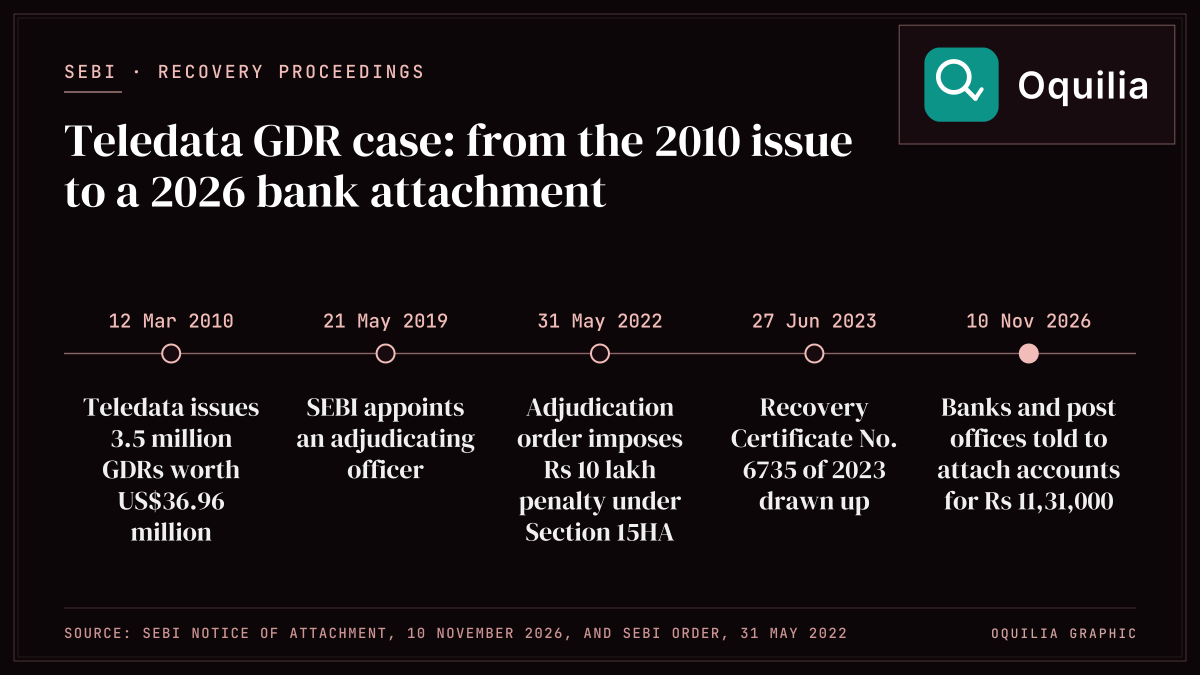
Mr Ravichandran was one of five directors who, according to the order, attended the 30 January 2010 board meeting that approved the EURAM Bank arrangements. The order held that the individual noticees were parties to the scheme. The procedural history it sets out is as follows. SEBI appointed an adjudicating officer on 21 May 2019 and issued a common show-cause notice on 24 July 2020. Because the notice could not be delivered to Mr Ravichandran by post, email or affixture, it was published in newspapers. Hearing notices for December 2021 and March 2022 followed, and the order records that he failed to attend either hearing.
The Law Invoked
The adjudicating officer held that the noticees, Mr Ravichandran among them, violated Section 12A(a), (b) and (c) of the SEBI Act, 1992, read with Regulations 3(a), (b), (c), (d) and 4(1) of the SEBI (Prohibition of Fraudulent and Unfair Trade Practices relating to Securities Market) Regulations, 2003. Section 12A bars using any manipulative or deceptive device in connection with securities and engaging in any act that operates as a fraud on investors. The PFUTP Regulations set out those prohibitions in more detail.
His penalty was imposed under Section 15HA of the SEBI Act, which provides for penalties for fraudulent and unfair trade practices. In fixing the amount, the officer considered the factors in Section 15J. The order also notes that a SEBI Whole Time Member's order dated 13 August 2021, in parallel proceedings, had already barred the individual noticees from the securities market for two years.
The attachment notice cites Sections 28A(1) and 11(2)(ia) of the SEBI Act, read with Section 226 and the Second Schedule to the Income-tax Act, 1961. Section 28A allows SEBI to recover unpaid penalties as if they were tax arrears, using the attachment and sale procedures that the Income-tax Act provides.
What Happens Next
Under the notice, every bank and post office in India must immediately attach any account or locker held by Mr Ravichandran, alone or jointly, together with any sums due to him. No debit may be made up to the full amount due until the Recovery Officer orders otherwise, although credits are still allowed. Within 15 days, institutions must send account details, a year of statements, confirmation of the attachment and details of any loan accounts. Any new account he opens must also be attached. If an institution does not reply, SEBI will presume it holds no account for him.
A SEBI adjudication order can be appealed to the Securities Appellate Tribunal (SAT), and a SAT ruling can be appealed to the Supreme Court. Neither the attachment notice nor the SEBI listing records any stay of the 2022 order. Recovery proceedings usually continue until the certificate amount is paid, after which SEBI publishes a completion notice. Attaching bank accounts is one of several recovery tools. The 2022 order also mentions attaching and selling movable and immovable property.
According to the 2022 order, Teledata is in liquidation, and the penalty against the company is to be lodged as a claim with its Official Liquidator.
What It Means
This case shows how long SEBI's enforcement process can take. The GDR issue took place in 2010, the penalty was imposed in 2022, the recovery certificate was drawn up in 2023 and the bank attachment came in November 2026. A penalty that goes unpaid does not lapse. It earns interest, is turned into a recovery certificate, and can lead to accounts, lockers and property being attached and sold.
For investors, the case points to the pattern SEBI has described in a series of GDR orders from that period. A listed company announces that it has raised foreign capital, but the issue is quietly paid for with a loan backed by the company's own proceeds, and the converted shares are then sold to Indian investors. Investors can watch for certain signs:
- a GDR or overseas issue taken up by one or two little-known subscribers;
- deposits held at a single foreign bank;
- annual-report notes describing large overseas cash balances that are never spent.
Before investing in a smaller listed company, read its exchange filings and annual reports and check SEBI's enforcement orders for its name. Shareholders of a company in liquidation, as Teledata is, generally rank last for any payout.
FAQ
What exactly did SEBI order on 10 November 2026?
SEBI's Recovery Officer in Chennai told all banks and post offices to attach R Ravichandran's accounts and lockers and to block debits up to Rs 11,31,000. This recovers the Rs 10 lakh penalty from the 2022 Teledata GDR order, plus interest and costs, under Recovery Certificate No. 6735 of 2023.
Is the SEBI finding against the person named a criminal conviction?
A SEBI adjudicating officer held in the order dated 31 May 2022 that the noticees, Mr Ravichandran among them, violated the anti-fraud provisions of the SEBI Act and PFUTP Regulations. This is a regulator's finding in civil proceedings and can be appealed to the Securities Appellate Tribunal. It is not a criminal conviction by a court.
Can the order be appealed?
SEBI adjudication orders can be appealed to the Securities Appellate Tribunal, with a further appeal to the Supreme Court. The attachment notice does not record any stay. Recovery proceedings enforce a penalty that is already due and are separate from any challenge to the original finding.
What happened to Teledata itself?
The 2022 order records that Teledata Technology Solutions Ltd is under liquidation. It was penalised Rs 10 crore under Section 15HA of the SEBI Act and Rs 10 lakh under Section 23E of the SCRA. SEBI held that the penalty may be lodged as a claim with the Official Liquidator.
How can I check a company or intermediary's enforcement record?
SEBI publishes adjudication orders, Whole Time Member orders and recovery notices in the Enforcement section of sebi.gov.in, where you can search by name. To check whether an intermediary is registered, use SEBI's list of registered intermediaries, and read exchange filings for a listed company's disclosures.
Where can I read the official documents?
The attachment notice and the 31 May 2022 adjudication order are both published on SEBI's website. Links to both appear in this report.
This report is based on the official SEBI notice of attachment dated 10 November 2026 and the SEBI adjudication order dated 31 May 2022, both published by SEBI.
This report describes enforcement actions and allegations on the public record, attributed to the officials cited. An order, FIR or chargesheet is not a conviction; parties are presumed innocent until proven guilty.
Named in this report, or spotted an error? Corrections and responses: editor@oquilia.com. We correct errors promptly and record responses from named parties.
Sources & Citations
- Notice of attachment dated November 10, 2026 issued against R Ravichandran under RC No.6735 of 2023 in the matter of Teledata Technology Solutions Limited — SEBI
- Unserved Adjudication order dated May 31, 2022 with respect to Mr. R Ravichandran in the matter of GDR Issue of Teledata Technology Solutions Ltd. — SEBI