

SEBI lets FPIs trade physically settled non-farm commodity derivatives from June 2027
SEBI has allowed foreign portfolio investors to trade physically settled non-agricultural commodity derivatives, with rules that make them exit before the delivery period, from 1 June 2027.
Key points
- SEBI, in a circular dated 27 November 2026, allowed FPIs into physically settled non-agricultural commodity derivative contracts.
- FPIs must exit or roll over positions before the tender or delivery period; the rules take effect from 1 June 2027.
- Open FPI positions left on the day before delivery will pass to a designated broker, who may charge a pre-agreed fee.
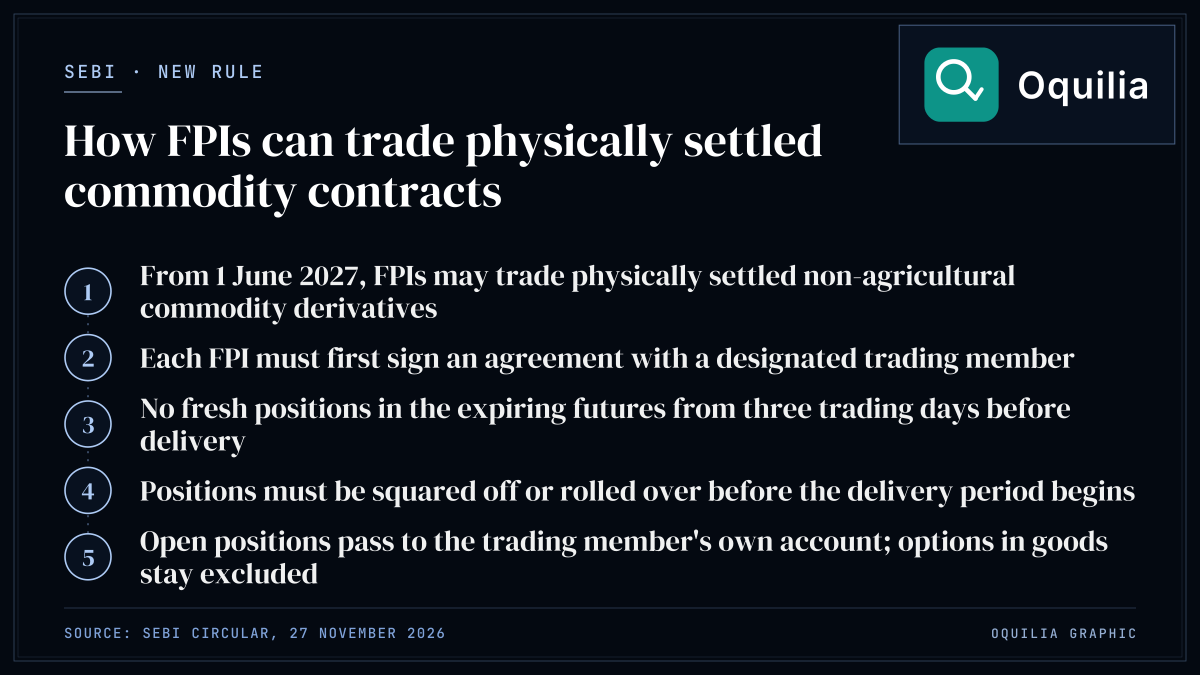
The Securities and Exchange Board of India (SEBI) has allowed foreign portfolio investors (FPIs) to trade non-agricultural commodity derivative contracts that are settled by physical delivery, not only those settled in cash. The circular, dated 27 November 2026 and sent to stock exchanges and clearing corporations with a commodity derivatives segment, takes effect from 1 June 2027.
What Happened
Until now, SEBI said, FPIs could take part in the commodity derivatives segment only through cash-settled non-agricultural contracts and indices of such commodities. SEBI said it decided to widen this after representations from market participants, deliberations of its Commodity Derivatives Advisory Committee and public comments on a consultation paper, to deepen institutional participation and liquidity. Options in goods remain excluded.
FPIs may hold physically settled contracts only until the tender or staggered delivery period begins, and must square off or roll over their positions before then. From three trading days before that period, they cannot add fresh positions in the expiring futures contract.
Each FPI must sign an agreement with a designated trading member before trading these contracts. Any position still open at the close of the day before delivery begins will pass automatically to that trading member's own account at the exchange's closing or daily settlement price, and the FPI will have no further rights or obligations in it. The trading member may charge a service fee and a pre-agreed "Risk Absorption Charge", which must be disclosed to the FPI at onboarding. A trading member pushed over its position limits by such a transfer gets up to two trading days to come back within them.
What It Means
Foreign investors will be able to trade a wider set of commodity contracts on Indian exchanges, while the rules are designed to keep them out of the physical delivery of goods. Exchanges and clearing corporations must standardise the onboarding agreement, amend their bye-laws, set up systems before 1 June 2027 and publish the change for market participants, including investors. Investors with complaints against SEBI-registered intermediaries can use https://scores.sebi.gov.in.
Source: SEBI circular
Sources & Citations
- SEBI circular — Securities and Exchange Board of India