

RBI issues Domestic Money Transfer Directions with Rs 25,000 monthly cap
The Reserve Bank of India has consolidated its rules for small cash-based money transfers into new Domestic Money Transfer Directions, 2026, effective immediately, with per-transaction and monthly limits.
Key points
- RBI issued the Reserve Bank of India (Domestic Money Transfer) Directions, 2026 on 11 November 2026, effective immediately.
- Cash pay-ins through agents or ATMs are capped at Rs 5,000 a transaction and Rs 25,000 a month per remitter, under the directions.
- Complaints about these transfers fall under the RBI's Integrated Ombudsman Scheme, 2026, RBI said.
The Reserve Bank of India (RBI) on 11 November 2026 issued the Reserve Bank of India (Domestic Money Transfer) Directions, 2026, bringing its rules for small cash-based money transfers into one document. The directions take effect immediately and apply to commercial banks, regional rural banks, co-operative banks and authorised payment system operators. RBI said the framework helps people, including migrant workers, who lack proof of identity or address to send small sums through formal banking channels.
What Happened
The directions, issued under the Payment and Settlement Systems Act, 2007, set out two services.
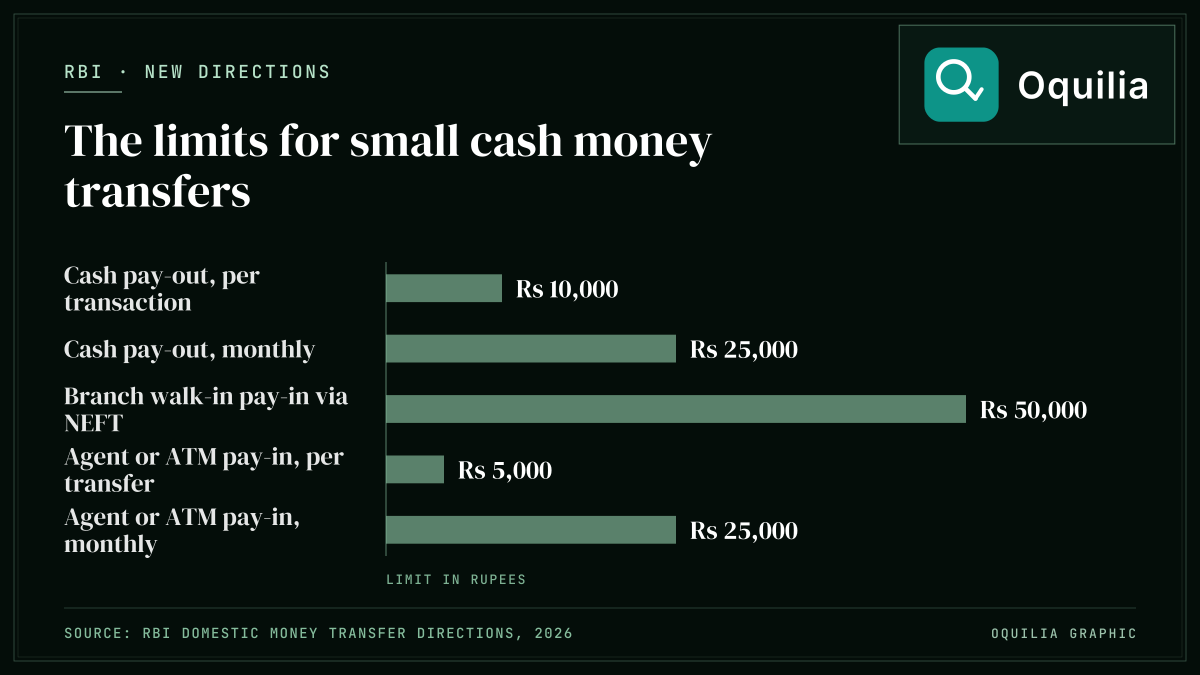
Under the cash pay-out service, a bank customer can send money from their account to a recipient who has no bank account, to be collected in cash at an ATM or through a business correspondent (a bank's authorised agent). The limit is Rs 10,000 per transaction, with a monthly ceiling of Rs 25,000 per beneficiary. The bank must keep a record of the beneficiary's name and address.
Under the cash pay-in service, a walk-in customer at a bank branch can send up to Rs 50,000 to a beneficiary's bank account through NEFT. Through business correspondents or ATMs, the limit is Rs 5,000 per transaction, with a monthly cap of Rs 25,000 per remitter. The remitter must be registered with a verified mobile number and a self-certified officially valid document, and every transaction must be confirmed with an additional factor of authentication.
Banks must run velocity checks, alert customers to credits made through these services, investigate any unusual spurt in credits to an account, and report suspicious transactions. Transfers are expected to be completed in real time or near real time. Banks may levy reasonable charges. The directions replace RBI circulars of 5 October 2011 and 24 July 2024.
What It Means
For people who send cash home through an agent, the limits are now set out in one place: Rs 5,000 a transfer and Rs 25,000 a month. Every transfer needs an extra authentication step, and banks must flag unusual activity. A customer with a complaint about such a transfer can take it to the RBI Ombudsman through https://cms.rbi.org.in.
Source: RBI notification
Sources & Citations
- RBI notification — Reserve Bank of India