

Missed the Form 10A deadline? CBDT Circular 1/2026 lets the jurisdictional PCIT or CIT condone delay in trust registration
CBDT Circular 01/2026 confirms the jurisdictional PCIT or CIT, not CPC Bengaluru, can condone delay in filing Form 10A under section 12A(1)(ac)(i) for reasonable cause.
Key points
- The CBDT clarified in Circular 01/2026, issued in March 2026, that the jurisdictional PCIT or CIT can condone delay in filing Form 10A.
- The condonation power comes from a proviso to section 12A(1)(ac) effective 01.10.2024, and applies where there is reasonable cause.
- Trusts with pending or new condonation requests should approach the jurisdictional PCIT or CIT, since a condoned application is deemed filed in time.
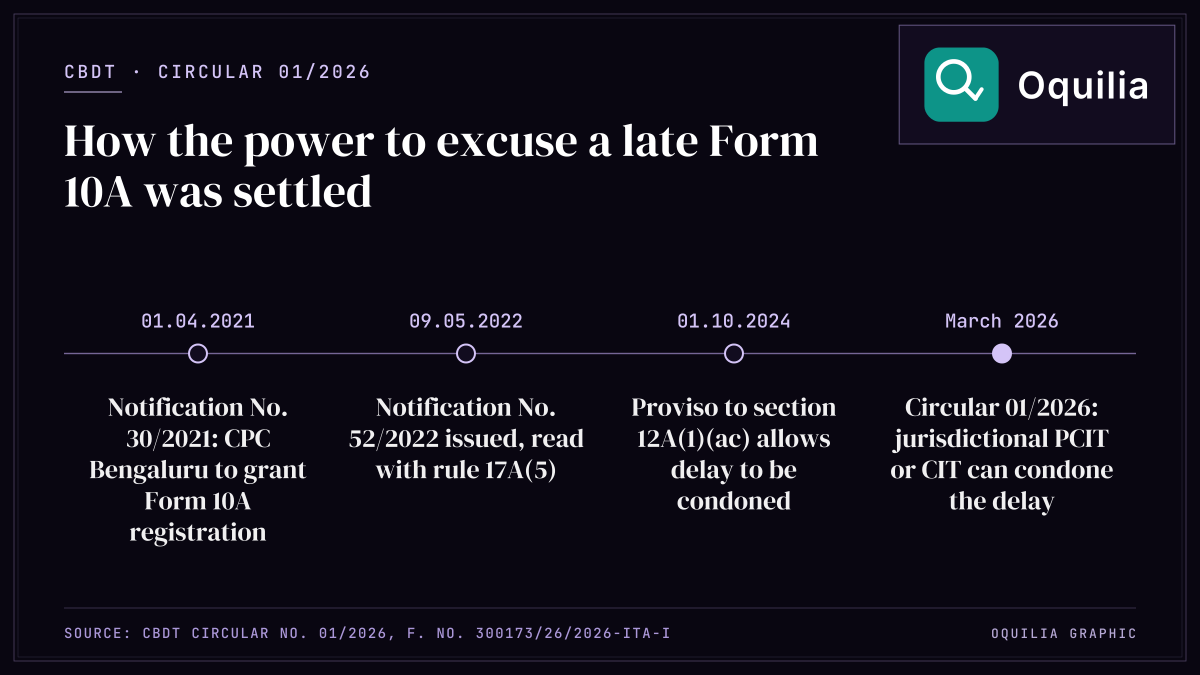
A charitable trust that files Form No. 10A late no longer has to wonder which income-tax office can forgive the delay. Under CBDT Circular No. 01/2026, F. No. 300173/26/2026-ITA-I, issued in March 2026 under section 119(2)(b) of the Income-tax Act, 1961, the Central Board of Direct Taxes says the jurisdictional Principal Commissioner of Income-tax (PCIT) or Commissioner of Income-tax (CIT) has the power to condone delay in filing Form 10A under section 12A(1)(ac)(i). The Board's stated aim is that eligible trusts are "not denied registration solely because of delay".
This explainer covers what section 12A requires, why the power to condone delay was unclear between 01.10.2024 and March 2026, how the circular settles it, and the mistakes trusts make when they ask for condonation. The circular itself is on the Income Tax Department portal, and the text of the 1961 Act is on India Code.
What the Section Says
Section 12A of the Income-tax Act, 1961 sets the conditions a trust or institution must meet before it can claim the tax exemption under sections 11 and 12. Sections 11 and 12 are the provisions that exempt income applied for charitable or religious purposes, so registration under section 12A is the gateway to both.
Section 12A(1)(ac)(i) is the specific clause at issue in Circular 01/2026. It requires a trust or institution seeking registration to file its application on Form No. 10A within the prescribed time. Miss that time limit and, before 01.10.2024, the application was simply late, with no express statutory route to have the delay excused.
With effect from 01.10.2024, a proviso was added to section 12A(1)(ac). It does two things:
- It empowers the Principal Commissioner or Commissioner to condone delay in filing the application where there is reasonable cause for that delay.
- Once the delay is condoned, the application is deemed to have been filed in time.
Why a clarification was needed
The confusion came from the rules, not the Act. Under rule 17A(5) of the Income-tax Rules, read with Notification S.O. 1443(E) (No. 30/2021 dated 01.04.2021) and Notification S.O. 2161(E) (No. 52/2022 dated 09.05.2022), the authority that actually grants registration on Form 10A is the Director of Income Tax (CPC), Bengaluru. Trusts and practitioners were therefore unsure whether a condonation request belonged with the centralised processing office in Bengaluru, which grants the registration, or with the jurisdictional PCIT or CIT named in the proviso.
Circular 01/2026 resolves that in one line: the jurisdictional PCIT or CIT has the power to condone delay in filing Form 10A under section 12A(1)(ac)(i).
| Function | Authority | Source |
|---|---|---|
| Grants registration on Form 10A | Director of Income Tax (CPC), Bengaluru | Rule 17A(5); Notification S.O. 1443(E) No. 30/2021 dated 01.04.2021; Notification S.O. 2161(E) No. 52/2022 dated 09.05.2022 |
| Condones delay in filing Form 10A | Jurisdictional PCIT or CIT | Proviso to section 12A(1)(ac), effective 01.10.2024; clarified by Circular 01/2026 |
| Enables the facility in the e-filing systems | DGIT (Systems), Delhi and Bengaluru | Direction in Circular 01/2026 |
| Issues the clarification | Central Board of Direct Taxes | Section 119(2)(b), Income-tax Act, 1961 |
Who the circular covers
The circular applies to two groups of cases where Form 10A was filed late:
- cases where the condonation application is already pending on the date of the circular; and
- cases where the condonation application is filed on or after the date of the circular.
The Board has also asked the Directorate General of Income Tax (Systems) at Delhi and Bengaluru to enable the facility in the systems, so the request can be handled through the department's IT platform rather than on paper alone.
Worked Example
The example below is illustrative. The names and rupee figures are hypothetical; the legal steps and dates come from the proviso to section 12A(1)(ac) and Circular 01/2026.
Suppose the Asha Vidya Trust runs two evening schools and received Rs 18,00,000 in donations in financial year 2025-26. Its trustees filed Form 10A 45 days after the prescribed time because the managing trustee was hospitalised for 5 weeks and the trust's only accountant resigned in the same month.
Step 1 — Is the delay covered? Yes. The proviso empowering condonation took effect on 01.10.2024, and the trust's condonation application would be filed after the March 2026 circular, which expressly covers applications "filed on or after the date of the circular".
Step 2 — Where does the request go? To the jurisdictional PCIT or CIT, not to the Director of Income Tax (CPC), Bengaluru. The CPC still grants the registration itself under rule 17A(5).
Step 3 — What must be shown? "Reasonable cause" for the 45-day delay. The trust should attach evidence: hospital discharge papers covering the 5 weeks and the accountant's resignation letter with its date.
Step 4 — What follows if condonation is granted? The Form 10A application is deemed filed in time, and the CPC processes it on that footing.
Step 5 — What is at stake? Without registration, the trust cannot claim exemption under sections 11 and 12 on the Rs 18,00,000 of receipts applied to its schools. With registration, that income is assessed under the charitable-trust provisions instead.
| Scenario | Condonation route | Result for the Rs 18,00,000 receipts |
|---|---|---|
| Form 10A filed within prescribed time | Not needed | Eligible for exemption under sections 11 and 12, subject to their conditions |
| Filed 45 days late, reasonable cause shown, PCIT/CIT condones | Proviso to section 12A(1)(ac), clarified by Circular 01/2026 | Application deemed filed in time; exemption route remains open |
| Filed 45 days late, no reasonable cause shown | PCIT/CIT may refuse to condone | Registration on Form 10A at risk; exemption under sections 11 and 12 not available on that application |
Trustees who also draw salaries or professional fees from other sources should keep their personal returns separate from the trust's affairs; the Oquilia income tax calculator and old vs new regime comparison handle individual liability, and the TDS calculator helps where the trust deducts tax on payments it makes.
Common Mistakes
These are the errors most likely to sink a condonation request after Circular 01/2026, each tied to the circular's own wording.
1. Sending the request to the CPC in Bengaluru. Rule 17A(5) and Notifications No. 30/2021 and No. 52/2022 make the Director of Income Tax (CPC), Bengaluru the registering authority, but the March 2026 circular places the condonation power with the jurisdictional PCIT or CIT. A request addressed to the wrong office loses time.
2. Assuming delay is excused automatically. The proviso effective 01.10.2024 lets the PCIT or CIT condone delay only "where there is reasonable cause". Circular 01/2026 clarifies who holds the power; it does not waive the reasonable-cause test.
3. Offering no evidence. A 45-day or 145-day delay is judged on the cause shown. Medical records, resignation letters, dated correspondence and similar documents carry weight; a bare statement does not.
4. Treating a pending application as dead. The circular expressly covers cases where a condonation application is pending on its date, so a trust that applied before March 2026 does not need to start again simply because the authority question was unsettled.
5. Confusing registration with exemption. Registration under section 12A is a condition for exemption under sections 11 and 12, not the exemption itself. A trust whose delay is condoned must still meet the other conditions of those sections for every assessment year.
6. Ignoring the systems route. The Board directed DGIT (Systems), Delhi and Bengaluru, to enable the facility in the systems. Trusts should check the e-filing portal at incometax.gov.in for the condonation option before relying only on a paper letter.
7. Reading the circular as a new deadline. Circular 01/2026 does not change the prescribed time for filing Form 10A under section 12A(1)(ac)(i), and it does not create a fresh window. It only confirms that the jurisdictional PCIT or CIT may excuse a delay for reasonable cause, as the proviso effective 01.10.2024 already allowed. Trusts that are not yet late should still file within the prescribed time rather than plan on condonation.
8. Losing track of the paper trail. Keep the Form 10A acknowledgement, the date of filing, the condonation application and any order of the PCIT or CIT together. If the CPC in Bengaluru later processes the registration, the condonation order is what shows the application is deemed filed in time.
FAQ
What does CBDT Circular 01/2026 clarify?
Issued in March 2026 under section 119(2)(b), F. No. 300173/26/2026-ITA-I, it clarifies that the jurisdictional Principal Commissioner or Commissioner of Income-tax has the power to condone delay in filing Form No. 10A under section 12A(1)(ac)(i) of the Income-tax Act, 1961.
Since when can delay in filing Form 10A be condoned?
The proviso to section 12A(1)(ac) that empowers the Principal Commissioner or Commissioner to condone delay took effect on 01.10.2024. Circular 01/2026 confirms which officer exercises that power.
Who grants registration on Form 10A?
Under rule 17A(5) read with Notification S.O. 1443(E) (No. 30/2021 dated 01.04.2021) and Notification S.O. 2161(E) (No. 52/2022 dated 09.05.2022), the Director of Income Tax (CPC), Bengaluru grants registration.
What happens once the delay is condoned?
Under the proviso to section 12A(1)(ac), the Form 10A application is deemed to have been filed in time, so registration is not refused solely because of the delay.
Does the circular apply to condonation requests filed before March 2026?
Yes, if they are still pending. Circular 01/2026 applies where Form 10A was filed late and the condonation application is pending on the date of the circular, or is filed on or after that date.
Is there a set list of acceptable reasons for delay?
The proviso uses the test of "reasonable cause" and the circular does not list specific reasons. Trusts should document the actual cause with dated evidence.
Can the request be filed online?
The Board asked DGIT (Systems), Delhi and Bengaluru, to enable the facility in the systems. Check the e-filing portal at incometax.gov.in for the option, and keep a copy of the circular, F. No. 300173/26/2026-ITA-I, with the application.
This explainer is general information based on CBDT Circular No. 01/2026 and is not legal or tax advice. Trusts with a pending or refused application should consult a chartered accountant or advocate.
Sources & Citations
- CBDT Circular No. 01/2026: Power to condone delay in filing Form No. 10A — Income Tax Department
- Income-tax Act, 1961 — India Code