

NPS exit money bounced or stuck? How CRAs now reinvest failed and pending payouts back into your PRAN after 30 days
PFRDA's 23 January 2026 circular lets the CRA reinvest failed or held NPS payouts into your PRAN after 30 days. Which six cases qualify, the market risk on reclaim, and the tax.
Key points
- PFRDA's circular of 23 January 2026 lets the CRA reinvest six more kinds of failed or held NPS payouts back into the subscriber's PRAN.
- The CRA reinvests the amount 30 days after it reaches the NPS Trust withdrawal account if corrected documents or clarifications have not arrived.
- Subscribers who answer the CRA's SMS or email within 30 days get a fixed sum; after reinvestment, any reclaim is subject to market fluctuations.
An NPS exit that has been authorised but never reaches your bank account used to sit idle. Since PFRDA Circular PFRDA/2026/06/SUP-TB/01, dated 23 January 2026, that money no longer waits indefinitely: after 30 days in the NPS Trust withdrawal account, the Central Recordkeeping Agency (CRA) puts it back into your Permanent Retirement Account Number (PRAN), invested as it was at exit. This guide explains which six kinds of stuck payout now qualify, what the 30-day clock means for you, how tax on the eventual withdrawal works, and what a Rs 50 lakh exit that bounces actually looks like in numbers.
The Scheme Explained
The National Pension System is regulated by the Pension Fund Regulatory and Development Authority (PFRDA), and every subscriber holds one PRAN that records contributions, units and withdrawals. When you exit or withdraw, the CRA processes the request, the money moves to the NPS Trust withdrawal account, and from there it is credited to your bank account. The 23 January 2026 circular deals with what happens when that last step fails or is held up.
Where the rule started: the February 2023 circular
PFRDA first allowed reinvestment through Circular PFRDA/2023/07/SUP-TB/01 of 7 February 2023. That circular let returned amounts go back into the same PRAN "based on the investment choice and pension fund allocation prevailing at the time of exit", so subscribers would keep earning market-linked returns. Under the 2023 rule, however, only one situation qualified: money that could not be credited because the subscriber's bank account details were incorrect.
Paragraph 2 of the 2026 circular admits the gap plainly. There were "other scenarios where transactions remain pending in the NPS system following the authorization of exit/withdrawal", and in each of them the subscriber earned nothing while the money waited. The 2026 circular, issued under Section 14(1) read with Section 14(2)(e) of the PFRDA Act, 2013, widens the list.
The six newly eligible cases
Paragraph 3 of the circular lists six categories that the CRA may now reinvest into the subscriber's PRAN, in addition to the 2023 wrong-bank-details case.
| Item | Situation covered by Circular PFRDA/2026/06/SUP-TB/01 | Typical trigger |
|---|---|---|
| (a) | Returned or failed credit to the subscriber's or nominee's bank account | Account closed, invalid IFSC, frozen or dormant account |
| (b) | Annuity cancellation proceeds returned by the Annuity Service Provider (ASP) | Subscriber exercised the free-look cancellation |
| (c) | Annuity cancellation proceeds in non-NPS cases | Old Pension Scheme (OPS) or family pension cases |
| (d) | Amount held by the CRA for quality monitoring | Clarification pending on the claim |
| (e) | Amount withheld by the CRA | Legal matters or disputes over the withdrawal request |
| (f) | Returned Tier II, partial and death withdrawal transactions | Any of these three payouts bouncing back |
Item (a) matters most for families: a death claim paid to a nominee whose account has since been closed now falls inside the rule, as does item (f) for death withdrawals. Item (b) covers the subscriber who bought an annuity, changed their mind within the free-look period, and had the premium returned by the insurer. Before 23 January 2026, none of these six cases qualified for reinvestment under the 2023 circular.
The 30-day clock
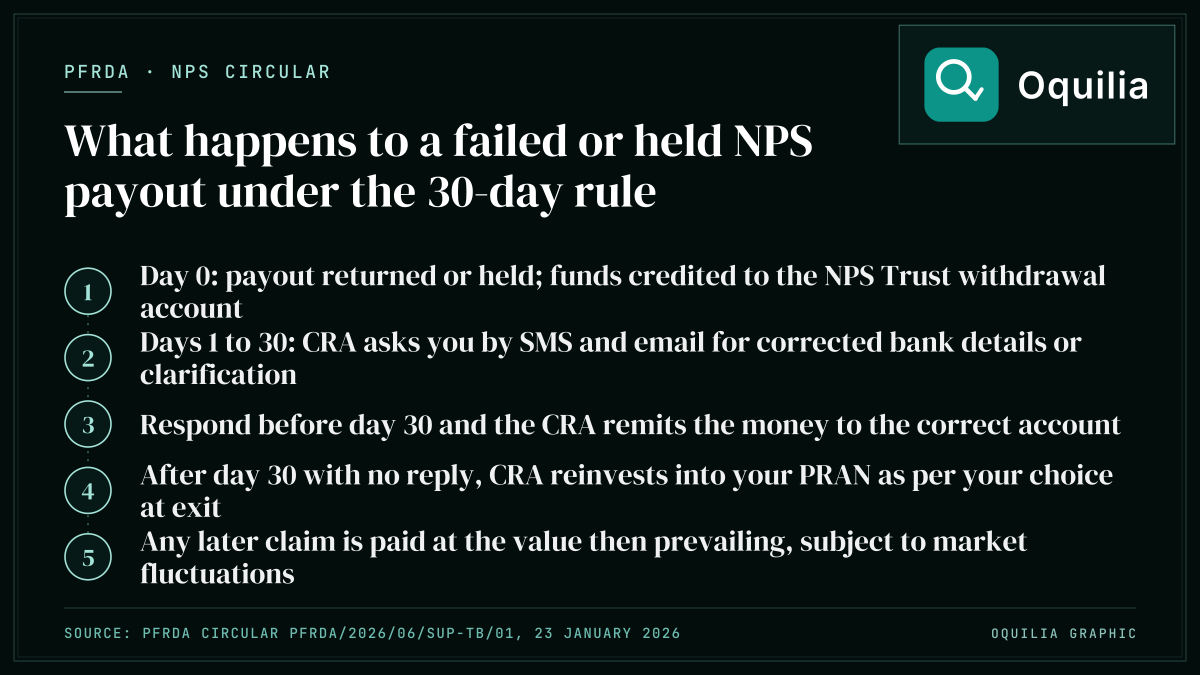
Paragraph 4 sets the timing. The CRA reinvests the returned amount "after a period of one month (30 days) from the date the funds are credited to the NPS Trust withdrawal account", but only where the required documents or clarifications have not arrived from the subscriber, the nodal office or the ASP. If you fix the problem inside 30 days, the money is sent to the corrected account instead.
Paragraph 5 sets out what the CRA must do during those 30 days. It will contact subscribers and nodal offices by SMS, email and other channels asking for the documents needed to send the money to the correct bank account. It will also tell the subscriber or nodal office about the proposed reinvestment if nothing is received within the window, and it will give "detailed instructions on the process for reclaiming the reinvested amount".
| Day (from credit to NPS Trust withdrawal account) | What happens under the 2026 circular |
|---|---|
| Day 0 | Payout returned or held; funds credited to the NPS Trust withdrawal account |
| Days 1 to 30 | CRA contacts you by SMS and email asking for corrected bank details or clarification |
| Before day 30 | If you respond, the CRA remits to the correct account |
| After day 30 | If nothing is received, CRA reinvests into your PRAN per your scheme choice and pension fund at exit, and tells you how to reclaim |
| Any later claim | Paid at the value then prevailing; "subject to market fluctuations" |
The catch: market risk on reclaim
The last line of paragraph 5 is the one to remember: "any future claims concerning the reinvested amount will be subject to market fluctuations." Once reinvested, your Rs 40 lakh is no longer a fixed sum owed to you; it is units in your pension fund. If markets fall 8% between reinvestment and reclaim, you get Rs 36.8 lakh back, and if they rise 8% you get Rs 43.2 lakh. The circular's stated aim is market-linked returns rather than none, but that cuts both ways.
How this sits with the exit limits
The reinvestment rule does not change how much you may take as a lump sum. Under the PFRDA (Exits and Withdrawals under the NPS) (Amendment) Regulations, 2025, explained in PFRDA's press release of 19 December 2025, non-government subscribers (All Citizen and corporate) may take up to 80% as a lump sum with at least 20% in an annuity. Government-sector subscribers remain at 60% lump sum and 40% annuity. A corpus of Rs 8 lakh or less may be taken entirely as a lump sum, or through the systematic options.
| Exit rule (normal exit) | Non-government sector | Government sector |
|---|---|---|
| Maximum lump sum | 80% | 60% |
| Minimum annuity | 20% | 40% |
| Full withdrawal allowed if corpus up to | Rs 8 lakh | Rs 8 lakh |
| Mid band (corpus above Rs 8 lakh up to Rs 12 lakh) | Lump sum capped at Rs 6 lakh | Lump sum capped at Rs 6 lakh |
| Partial withdrawal | Up to 25% of own contributions | Up to 25% of own contributions |
You can model your own split with Oquilia's NPS calculator.
Tax on Withdrawal
The 23 January 2026 circular says nothing about income tax. It is an operational rule on where stuck money sits, not a change to the Income-tax Act, 1961, and it does not say whether reinvestment or a later reclaim is treated as a fresh transaction for tax. Treat the points below as the existing rules for NPS payouts, and confirm with a tax adviser how they apply to a reinvested and reclaimed amount.
Lump sum at exit: the 60% exemption
Section 10(12A) of the Income-tax Act exempts the payment from the NPS Trust on closure or opting out "to the extent it does not exceed sixty per cent of the total amount payable", a limit in force since 1 April 2020. The text is published on the Income Tax Department's portal. PFRDA's 80% lump-sum limit of 19 December 2025 is a regulatory limit; PFRDA has no power over the Income-tax Act, and no Finance Act change aligning 10(12A) to 80% has been found.
So on a Rs 50 lakh non-government exit taken at 80%, Rs 30 lakh (60%) is covered by 10(12A). The remaining Rs 10 lakh slice, between 60% and 80%, is not covered by that exemption, and its treatment does not follow from the section as written. Do not assume it is tax-free, and do not assume a particular rate either; ask a chartered accountant before you file.
Partial withdrawal: Section 10(12B)
Partial withdrawals are exempt under Section 10(12B) to the extent they do not exceed 25% of the contributions made by the subscriber. That matches PFRDA's own partial withdrawal limit of 25% of own contributions, after at least 3 years in the scheme, up to 4 times before age 60 with a 4-year gap. A returned partial withdrawal is now explicitly covered by item (f) of the 2026 circular.
Annuity income: taxed at your slab
The annuity bought with at least 20% (or 40% in the government sector) of the corpus pays a regular pension, and that pension is taxed at your slab rate in the year you receive it. Under the new regime for FY 2025-26, slabs run from nil up to Rs 4 lakh, 5% from Rs 4 lakh to Rs 8 lakh, 10% to Rs 12 lakh, 15% to Rs 16 lakh, 20% to Rs 20 lakh, 25% to Rs 24 lakh and 30% above, with 4% health and education cess. The Section 87A rebate in the new regime is up to Rs 60,000 where total income does not exceed Rs 12 lakh.
| Payout | Exemption section | How it is taxed |
|---|---|---|
| Lump sum at exit, up to 60% of corpus | 10(12A) | Exempt |
| Lump sum between 60% and 80% (non-government) | Not covered by 10(12A) | Confirm with a tax adviser |
| Partial withdrawal up to 25% of own contributions | 10(12B) | Exempt |
| Annuity pension | None | Slab rate in year of receipt, plus 4% cess |
| Annuity premium returned after free-look | Not addressed by the circular | Confirm with a tax adviser |
For the free-look case, item (b), note one practical point: if the cancelled premium is reinvested and you later reclaim it, you still have to meet the minimum annuity requirement of your exit, so the money will normally end up buying a fresh annuity. The TDS and reporting treatment of that sequence is not set out in the circular.
Worked Drawdown
The example below is an illustration, not a forecast. The returns used are assumptions chosen to show the arithmetic.
Step 1: the exit
Meera, a 60-year-old All Citizen Model subscriber, has a corpus of Rs 50 lakh. She chooses the maximum 80% lump sum, Rs 40 lakh, and puts the minimum 20%, Rs 10 lakh, into an annuity. Her request is authorised in March, but the savings account she named was closed when she moved cities, so the Rs 40 lakh credit fails and returns to the NPS Trust withdrawal account.
Step 2: the 30-day window
Under paragraph 5, the CRA sends Meera SMS and email messages asking for an updated bank account. If she submits the details by day 30, she receives the full Rs 40 lakh. Before 23 January 2026, a closed-account failure like hers (as distinct from wrong details entered at the outset) was not listed for reinvestment, and the money would simply have waited.
Step 3: reinvestment and the reclaim value
Suppose Meera misses the messages. On day 31 the CRA reinvests Rs 40 lakh into her PRAN using the scheme choice and pension fund she had at exit. What she receives when she reclaims depends on the market between reinvestment and payout.
| Change in fund value before reclaim (assumed) | Amount reclaimed | Gain or loss vs Rs 40 lakh |
|---|---|---|
| -8% | Rs 36,80,000 | -Rs 3,20,000 |
| -3% | Rs 38,80,000 | -Rs 1,20,000 |
| +3% | Rs 41,20,000 | +Rs 1,20,000 |
| +8% | Rs 43,20,000 | +Rs 3,20,000 |
The lesson from the table is that the 30-day window is your only point of certainty. Answering the CRA's message in that period locks in Rs 40 lakh; letting it pass converts the payout into market-linked units.
Step 4: a 10-year drawdown of the reclaimed lump sum
Assume Meera reclaims the full Rs 40 lakh and draws Rs 4 lakh at the start of each year from an investment earning an assumed 7% a year. The table tracks the corpus over 10 years.
| Year | Withdrawn (start of year) | Growth at 7% (assumed) | Balance at year end |
|---|---|---|---|
| 1 | Rs 4,00,000 | Rs 2,52,000 | Rs 38,52,000 |
| 2 | Rs 4,00,000 | Rs 2,41,640 | Rs 36,93,640 |
| 3 | Rs 4,00,000 | Rs 2,30,555 | Rs 35,24,195 |
| 4 | Rs 4,00,000 | Rs 2,18,694 | Rs 33,42,888 |
| 5 | Rs 4,00,000 | Rs 2,06,002 | Rs 31,48,891 |
| 6 | Rs 4,00,000 | Rs 1,92,422 | Rs 29,41,313 |
| 7 | Rs 4,00,000 | Rs 1,77,892 | Rs 27,19,205 |
| 8 | Rs 4,00,000 | Rs 1,62,344 | Rs 24,81,549 |
| 9 | Rs 4,00,000 | Rs 1,45,708 | Rs 22,27,258 |
| 10 | Rs 4,00,000 | Rs 1,27,908 | Rs 19,55,166 |
After 10 years and Rs 40 lakh of total withdrawals, about Rs 19.55 lakh remains. If the reclaimed amount had come back 8% lower at Rs 36.8 lakh, the same Rs 4 lakh draw would leave a smaller balance at every step. Test your own figures in the retirement drawdown calculator, and compare a systematic withdrawal against buying a larger annuity with the annuity vs SWP calculator.
Before filing any of the six withdrawal types, check that the bank account linked to your PRAN is active and that the CRA has your current mobile number and email, since the 30-day messages go there. The full circular is on PFRDA's website.
FAQ
What did PFRDA change on 23 January 2026?
Circular PFRDA/2026/06/SUP-TB/01 extended reinvestment into the PRAN, first allowed on 7 February 2023 only for incorrect bank details, to six more cases: failed credits to subscriber or nominee accounts, free-look annuity cancellations, non-NPS annuity cancellations, CRA quality holds, legal-dispute holds, and returned Tier II, partial and death withdrawals.
How long does the CRA wait before reinvesting my money?
The CRA waits 30 days from the date the funds are credited to the NPS Trust withdrawal account. It reinvests only if the required documents or clarification have not been received from you, your nodal office or the ASP within that period.
Will I be told before my money is reinvested?
Yes. Paragraph 5 of the circular requires the CRA to contact you by SMS, email and other modes during the 30 days, to notify you of the proposed reinvestment if nothing is received, and to give detailed instructions for reclaiming the amount.
Can I lose money if my payout is reinvested?
Yes. The circular states that any future claim on the reinvested amount "will be subject to market fluctuations". On a Rs 40 lakh payout, an 8% fall before reclaim would return Rs 36.8 lakh, while an 8% rise would return Rs 43.2 lakh.
Does reinvestment change the tax on my NPS lump sum?
The circular does not address tax. Under existing law, Section 10(12A) exempts up to 60% of the amount payable on exit and Section 10(12B) exempts partial withdrawals up to 25% of your own contributions; confirm with a tax adviser how these apply to an amount that was reinvested and later reclaimed.
Does the rule cover a nominee's death claim?
Yes. Item (a) covers credits that failed to reach the nominee's bank account, and item (f) covers returned death withdrawal transactions, so a nominee whose account was closed, dormant or had an invalid IFSC is within the 30-day reinvestment process.