

Madras High Court cancels statutory bail of accused in ED loan-promise cheating case
The Madras High Court held on 25 November 2026 that the ED's e-filed prosecution complaint was filed in time, cancelled an accused's statutory bail and directed him to surrender.
Key points
- The Madurai Bench of the Madras High Court allowed the ED's revision and set aside a statutory bail order of 13 May 2026.
- The ED alleges proceeds of crime of about Rs 25.99 crore from cheating investors on a false promise of loans.
- The accused must surrender by 27 November 2026 and may apply for bail on merits; the allegations are yet to be tested at trial.
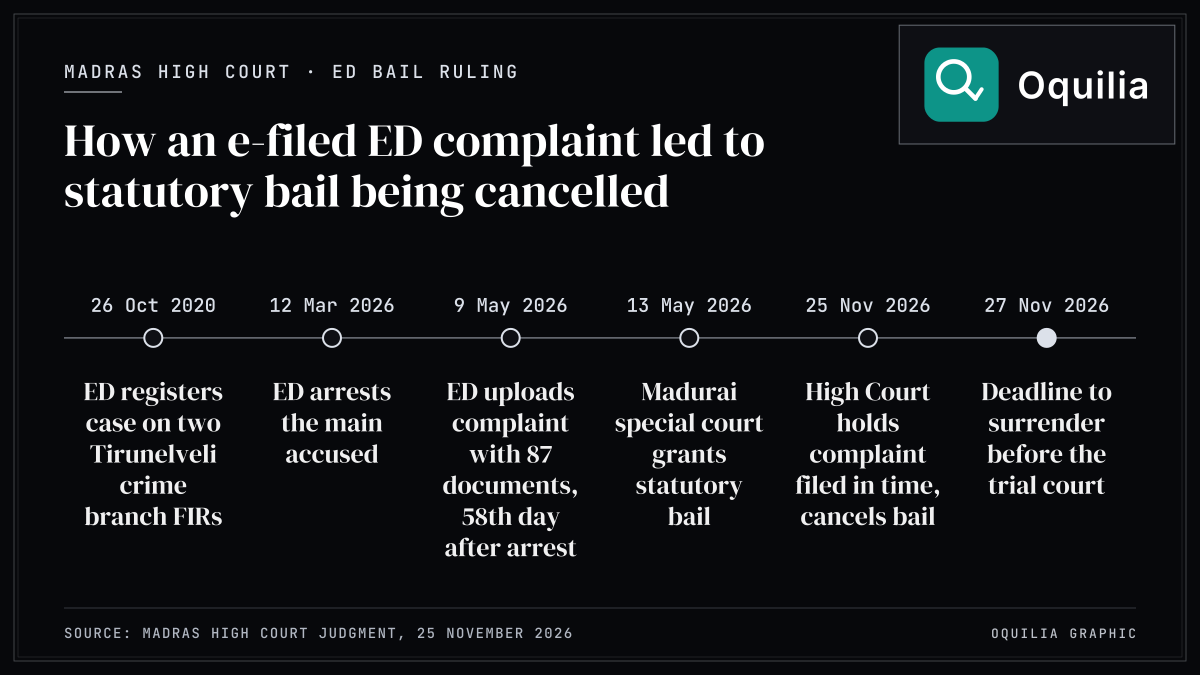
The Madurai Bench of the Madras High Court on 25 November 2026 cancelled the statutory bail granted to the main accused in a money laundering case of the Enforcement Directorate (ED), and directed him to surrender before the trial court by 27 November 2026. The court held that the ED had filed its prosecution complaint within the 60-day limit when it uploaded it through the e-filing portal.
What Happened
According to the ED, investors were cheated on the false promise of loans, generating proceeds of crime of about Rs 25.99 crore, which remain untraced. The ED registered its case on 26 October 2020 on the basis of two FIRs of the City Crime Branch, Tirunelveli, and arrested the accused on 12 March 2026.
Statutory bail, also called default bail, is a right that arises if an investigating agency does not file its charge sheet or complaint within the time the law allows. The ED uploaded its complaint with 87 documents on 9 May 2026, the 58th day after the arrest. A special court in Madurai granted the accused statutory bail on 13 May 2026, after the complaint was treated as received only that day and returned for want of a memo of appearance for the prosecutor.
The High Court held that the law requires only that the complaint be filed within the period, which the e-filing record showed. It said verifying 87 documents in under seven minutes was "humanly impossible" and the return of the complaint "wholly unjustifiable". The complaint was later taken on file against 13 accused for offences under Sections 3, 4, 8(5) and 70 of the PMLA. The accused's own plea to relax a daily-reporting bail condition was dismissed as infructuous.
These are allegations, not findings of guilt; the accused are presumed innocent until proven guilty in court, and due process continues.
What It Means
The ruling says a complaint uploaded on time through the court's e-filing portal counts as filed, so a delay in a court registry processing it does not create a right to default bail. The accused may still apply for regular bail on merits; if he does not surrender, the ED may arrest him. Anyone who has lost money to a loan offer can report it at https://cybercrime.gov.in or on helpline 1930.
Source: High Court judgment
Sources & Citations
- High Court judgment — Madras High Court