

Kerala High Court says RBI must consult state before superseding co-op bank board
The Kerala High Court held that RBI must consult the State Government, not only the Registrar, before removing a co-operative bank's board, and ordered status quo at Irinjalakuda Town Co-operative Bank for one month.
Key points
- A Kerala High Court bench on 17 November 2026 dismissed appeals by RBI and a former president of Irinjalakuda Town Co-operative Bank.
- The court held that consulting the Registrar of Co-operative Societies is not the consultation with the State Government that Section 36AAA requires.
- The court ordered status quo for one month, as RBI's 6 October 2026 extension of the bank's administrator was issued without that consultation.
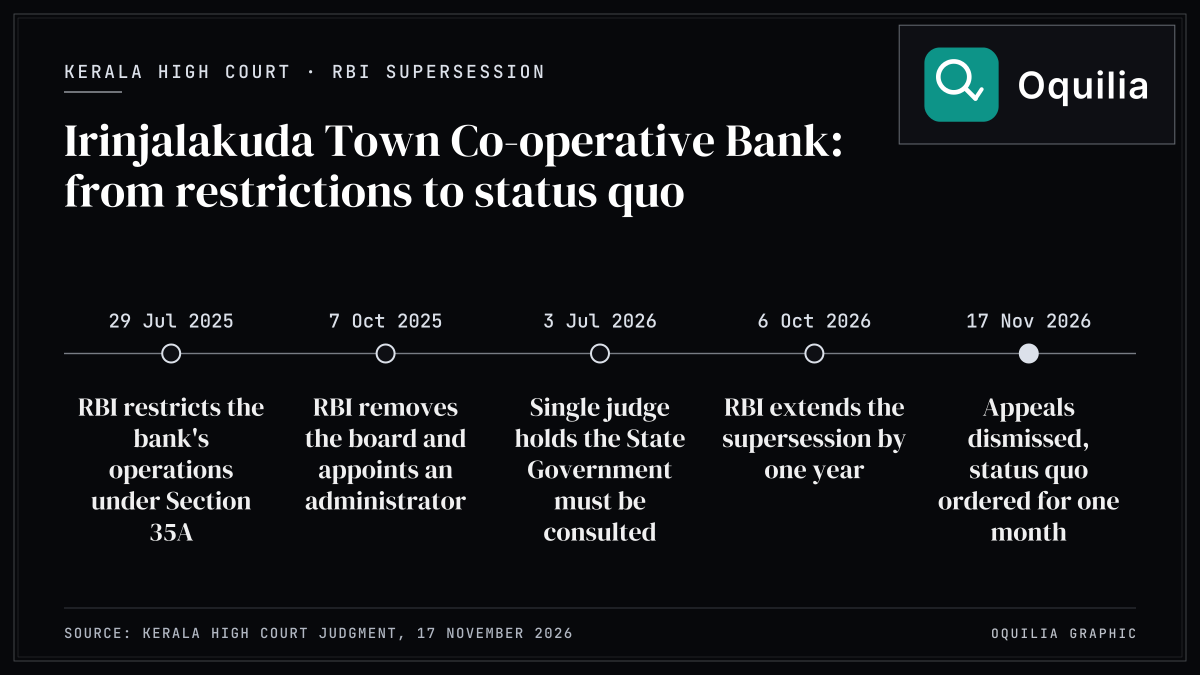
The Kerala High Court on 17 November 2026 held that the Reserve Bank of India (RBI) must consult the State Government before superseding the board of a co-operative bank, and that consulting the Registrar of Co-operative Societies is not enough. A two-judge bench dismissed appeals by RBI and by a former president of Irinjalakuda Town Co-operative Bank in Thrissur district, and ordered status quo for one month.
What Happened
According to the judgment, RBI restricted the bank's operations under Section 35A of the Banking Regulation Act, 1949, by an order of 29 July 2025. On 7 October 2025 it removed the bank's board of directors and appointed an administrator under Section 36AAA read with Section 56 of the Act. The former president challenged that order.
On 3 July 2026 a single judge held that the law requires consultation with the State Government, and that RBI had consulted only the Registrar. The judge still declined to set the order aside, because the administrator had run the bank for nearly nine months, but directed that any continuation after 6 October 2026 be done only in consultation with the State Government.
The appeal bench agreed. It held that when a statute says how something must be done, it must be done that way. It also upheld the single judge's refusal to undo the administrator's term, on grounds of equity and public interest. The court noted that RBI issued an order on 6 October 2026 extending the supersession by one year from 7 October 2026, and held that this extension "will have no independent legs to stand", since consultation with the State Government was not completed. To avoid a vacuum while that consultation is completed, it ordered status quo for one month from the date of the judgment.
What It Means
For depositors of co-operative banks, the ruling sets out a procedural check on RBI's power to remove an elected board: the State Government itself must be consulted, not only the Registrar. For Irinjalakuda Town Co-operative Bank, the present arrangement continues for one month while that consultation takes place. The judgment does not set aside RBI's original order and says nothing on the bank's finances. Customers with a complaint against a regulated bank can approach RBI at https://cms.rbi.org.in.
Source: High Court judgment
Sources & Citations
- High Court judgment — Kerala High Court