

Jharkhand High Court refuses to quash 1992 bribery case against three examiners
The Jharkhand High Court refused to quash a 1992 case in which three polytechnic examiners are accused of taking bribes, but set aside the charge framed under the amended 2018 law.
Key points
- The Jharkhand High Court on 3 November 2026 refused to quash a 1992 vigilance case against three accused polytechnic examiners.
- The court set aside the charge framed under the 2018 amended law, holding the alleged offence falls under the 1988 Act.
- The trial court must frame the charge afresh, and the three accused must appear before it on 1 December 2026.
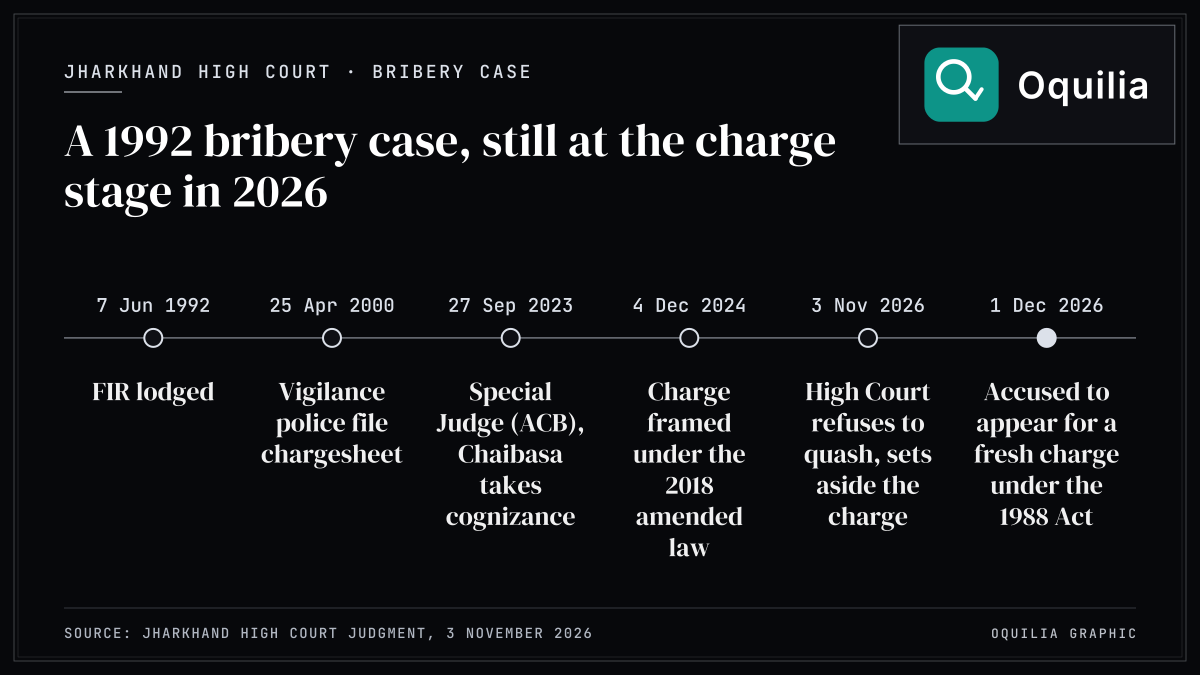
The Jharkhand High Court on 3 November 2026 refused to quash a 1992 bribery case against Badri Narayan Lal, Mahendra Prasad Singh and Sheo Dahin Prasad Singh, who are accused of taking illegal gratification as public servants evaluating answer sheets of a polytechnic examination at the Government Polytechnic, Adityapur. The court set aside the charge framed against them under the amended anti-corruption law and sent the case back to the trial court to frame the charge afresh.
What Happened
According to the charge quoted in the judgment, the three are accused of taking gratification on or about 6 June 1992 for evaluating answer sheets. An FIR was lodged on 7 June 1992, the vigilance police filed a chargesheet on 25 April 2000, and the Special Judge (ACB), West Singhbhum at Chaibasa took cognizance on 27 September 2023. On 4 December 2024 the trial court framed a charge under Section 7(a) of the Prevention of Corruption Act as amended in 2018.
The three, now aged between 78 and 84, argued that cognizance was taken under repealed provisions and that a delay of more than 30 years violated their right to a speedy trial.
The High Court held that citing repealed provisions in the cognizance order was an irregularity that caused no prejudice, and that the sanction for prosecution of all 11 accused was on record. But because the alleged offence dates from the period when the Prevention of Corruption Act, 1988 was in force, the charge under the 2018 amended law "cannot be sustained", the court held. It rejected the plea to quash the case for delay, noting the allegations are serious and the accused were on bail throughout.
These are allegations, not findings of guilt; the accused are presumed innocent until proven guilty in court, and due process continues.
What It Means
The prosecution continues. The trial court must pass a fresh order on the charge under the 1988 Act, and the three must appear before it on 1 December 2026. The High Court asked the parties to cooperate so that the case, from an FIR of 1992, ends at the earliest.
A demand for a bribe by an official can be reported to the state anti-corruption bureau; Oquilia's guide to every state's helpline is at https://www.oquilia.com/report-a-bribe.
Source: High Court judgment
Sources & Citations
- High Court judgment — Jharkhand High Court