

Delhi High Court lets HDFC Bank sell loan-financed car held as case property
The Delhi High Court on 23 November 2026 allowed HDFC Bank to auction a car bought with its auto loan and held as case property, after the car lost about 47% of its value while idle.
Key points
- The Delhi High Court set aside a trial court order and allowed HDFC Bank to sell a car held as case property in a criminal case.
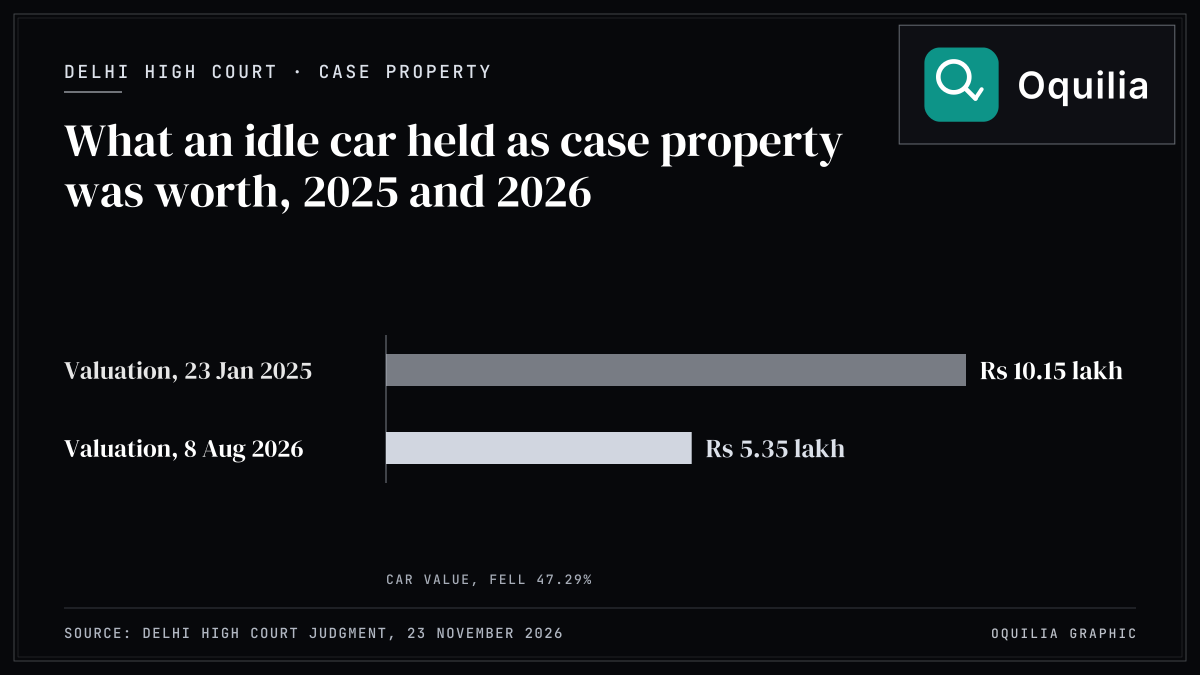
- Valuation reports showed the car's value fell from Rs 10.15 lakh to Rs 5.35 lakh, a drop of 47.29%, while it stood idle.
- The car will be recorded by police before a public auction, and the sale money will be credited to the borrower's loan account.
The Delhi High Court on 23 November 2026 allowed HDFC Bank to sell a car that one of its auto-loan borrowers had bought and that is case property in a criminal trial. Justice Sachin Datta set aside a Saket sessions court order of 12 September 2025 that had refused the bank permission to sell it.
What Happened
The car belongs to one of the accused in a 2022 Delhi Police Crime Branch FIR under the Indian Penal Code, the Immoral Traffic (Prevention) Act and the Foreigners Act. It was bought with an HDFC Bank auto loan and was handed over to the bank for safe keeping on 9 December 2024, with no objection from the investigating officer or the owner. The investigating officer also had no objection to its sale, but the trial court refused, saying a sale before evidence was recorded might affect the trial.
The High Court relied on Section 497 of the Bharatiya Nagarik Suraksha Sanhita, which lets a court order property sold during a trial when it is subject to decay or it is otherwise expedient. It noted that the car had stood idle for at least two years and that valuation reports put its value at Rs 10.15 lakh on 23 January 2025 and Rs 5.35 lakh on 8 August 2026, a fall of 47.29%. The court held that the car is not the subject of the offence, and that a detailed panchnama, the official record of the property, with photographs and video will be enough evidence at the trial.
The FIR's contents are allegations, not findings of guilt; the accused are presumed innocent until proven guilty in court, and due process continues.
What It Means
The bank must produce the car before the investigating officer within a week. The officer will prepare a panchnama with photographs from all angles and video, in the presence of the owner's representative. The sale cannot take place for three weeks after that, and must be by public auction or another transparent process. The officer will issue a no-objection certificate for transfer of registration, and the sale money will be credited to the loan account. The ruling follows the line, cited by the court, that returning or selling seized vehicles should be the norm rather than the exception, so that they do not lose value while a case runs.
Source: High Court judgment
Sources & Citations
- High Court judgment — Delhi High Court