

Cabinet clears Rs 2,814 crore capex subsidy scheme for lithium and nickel processing
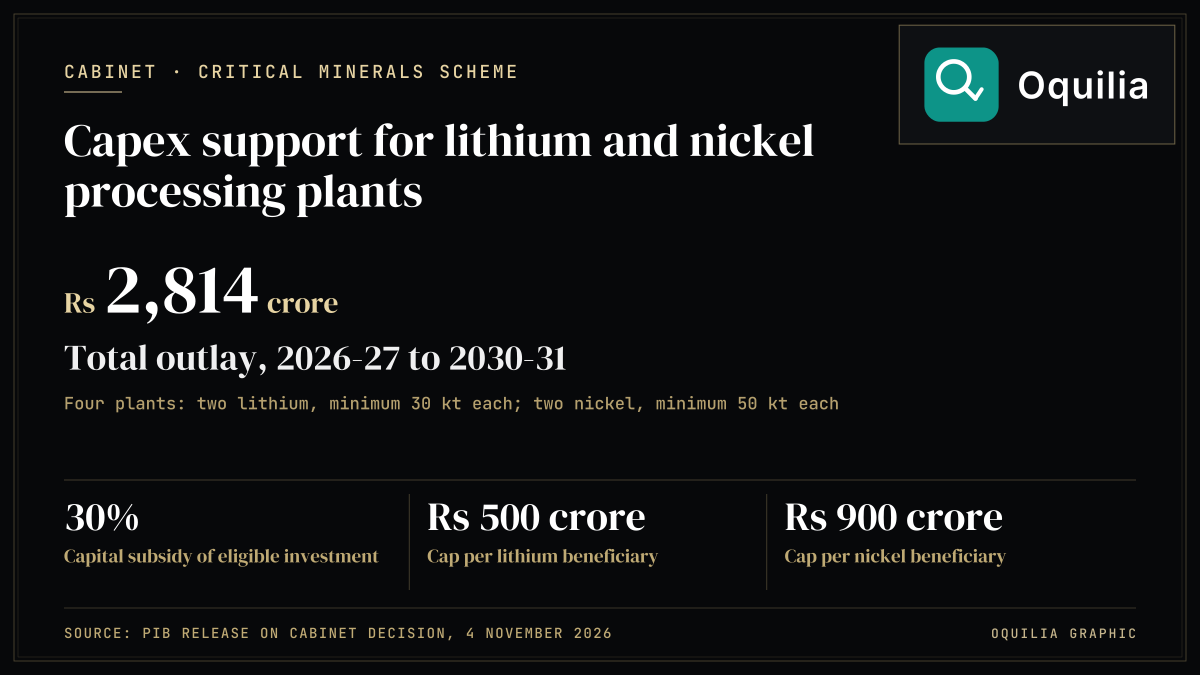
The Union Cabinet approved a Rs 2,814 crore scheme paying a 30% capital subsidy for four lithium and nickel processing plants from 2026-27 to 2030-31.
Key points
- The Union Cabinet has approved a capex support scheme to promote critical mineral processing, a release posted on 4 November 2026 said.
- The scheme has an outlay of Rs 2,814 crore and pays a 30% subsidy, capped at Rs 500 crore per lithium and Rs 900 crore per nickel plant.
- Two lithium and two nickel plants will be chosen through technical screening and bids seeking the lowest support, with payment in three instalments.
The Union Cabinet has approved a Rs 2,814 crore scheme that will pay a capital subsidy for setting up plants in India to process lithium and nickel into high-purity compounds, according to a government release posted on 4 November 2026. The scheme runs from 2026-27 to 2030-31 and will back four plants.
What Happened
The Cabinet, chaired by the Prime Minister, cleared the "Capex Support Scheme to Promote Critical Mineral Processing" with a total outlay of Rs 2,814 crore over a period of five years.
Under the scheme, the government will pay a capital subsidy of 30% of eligible investment to set up four processing plants: two lithium plants with a minimum capacity of 30 kt each, and two nickel plants with a minimum capacity of 50 kt each. Support is capped at Rs 500 crore for each lithium beneficiary and Rs 900 crore for each nickel beneficiary. The release says cobalt is also expected to be recovered as a by-product of nickel processing.
Beneficiaries will be chosen in two stages. Applications will first be assessed for technical eligibility, and only applicants that qualify will move to a second stage of financial bids. For each mineral, two beneficiaries will be selected on a least-cost basis, meaning the bidders that seek the lowest capex support. The subsidy will be paid in three instalments, each tied to reaching set milestones.
The release says India's processing infrastructure for critical minerals such as lithium, nickel and cobalt is at an early stage, so the country relies heavily on imports of refined intermediate and high-purity materials, and global processing is concentrated in a few places.
What It Means
The scheme aims to build processing capacity at home, reduce import dependence and develop the value chain, the release says. It names electric mobility, battery energy storage systems, electronics, defence and speciality steel as sectors it will support.
For companies and their shareholders, the subsidy is open only through the two-stage selection, and only four plants will receive it. The release does not name any eligible company or give a date for inviting applications.
Source: PIB release on Cabinet decision
Sources & Citations
- PIB release on Cabinet decision — Press Information Bureau