

Bombay High Court acquits former Phulambri tahsildar Uttam Tupe in 2006 ACB bribery case
The Bombay High Court at Aurangabad has set aside a former Phulambri tahsildar's 2015 bribery conviction and upheld a naib-tahsildar's acquittal, holding the demand was not proved.
Key points
- The Bombay High Court at Aurangabad on 3 November 2026 acquitted a former Phulambri tahsildar and set aside his 2015 bribery conviction.
- A Special Court had sentenced him to up to four years in prison and fines of Rs 5,000 and Rs 10,000 in a 2006 trap case over Rs 4,000.
- The court also dismissed the state's appeal against a naib-tahsildar's acquittal, holding the prosecution failed to prove any bribe demand.
The Bombay High Court, at its Aurangabad bench, has acquitted Uttam Tupe, former tahsildar of the Tahsil Office at Phulambri in Aurangabad district, in a 2006 Anti-Corruption Bureau (ACB) bribery case, setting aside his 2015 conviction. In the same judgment, pronounced on 3 November 2026, the court dismissed the state's appeal against the acquittal of Pranali Tayade, then a naib-tahsildar in the same office. The former tahsildar died while his appeal was pending, and it was continued by his legal heirs.
What Happened
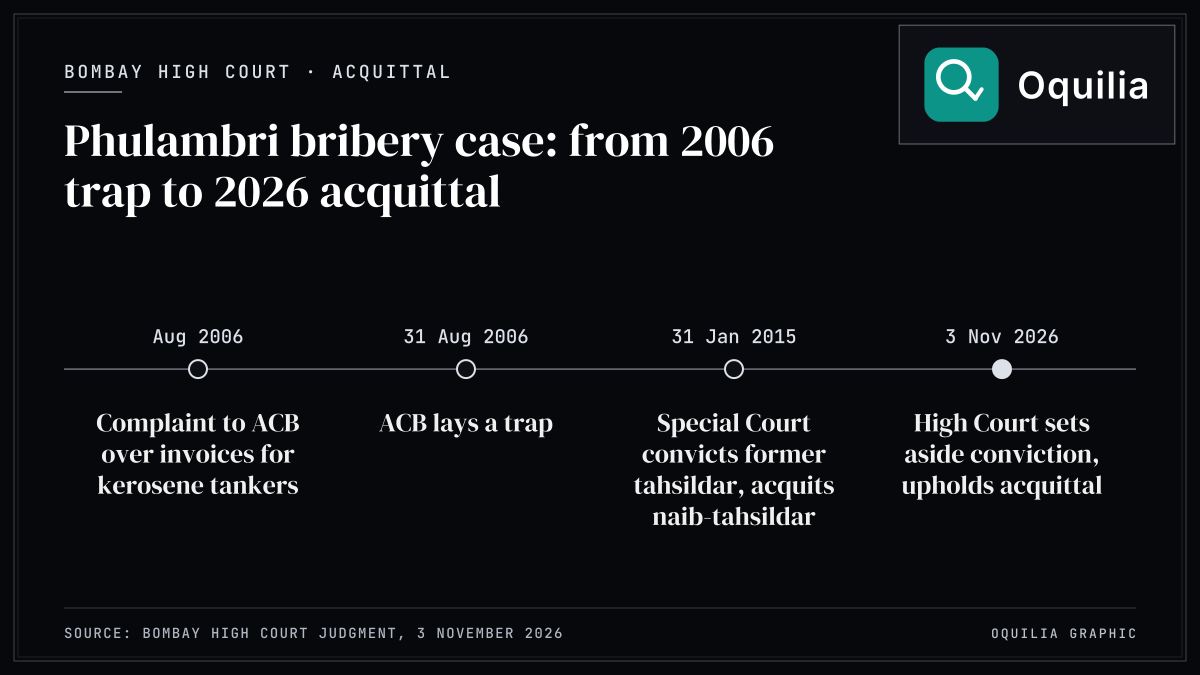
According to the judgment, a man who looked after a kerosene agency complained to the ACB in August 2006 that officials of the Tahsil Office had demanded money to issue invoices for kerosene tankers. A trap was laid on 31 August 2006. On 31 January 2015, a Special Court (PC Act) in Aurangabad convicted the tahsildar under Sections 7 and 13(2) read with Section 13(1)(d) of the Prevention of Corruption Act, 1988, and sentenced him to three years' rigorous imprisonment and a fine of Rs 5,000, and four years and a fine of Rs 10,000, to run concurrently. It acquitted the naib-tahsildar.
The High Court held that the prosecution had not proved a demand for a bribe with cogent evidence. It noted that the complainant's evidence gave no date for the first demand, that the panch witness was not inside the house during the alleged handover, and that witnesses differed on the recovery. It found no compliance with Section 65-B of the Indian Evidence Act for the recorded conversation. It accepted as probable the defence that the Rs 4,000 was repayment of an outstanding hand loan, which the complainant had admitted. It held that the acquittal of the naib-tahsildar was based on the evidence and not perverse.
What It Means
Both officials now stand acquitted; the court ordered any fine paid to be refunded and bail bonds cancelled. In law the accusations against them were not proved, and they are presumed innocent.
The ruling restates that, in a bribery case, the prosecution must prove a specific demand linked to official work; recovering money alone is not enough. Anyone asked for a bribe by an official can report it to the state anti-corruption bureau; Oquilia's guide to every state's helpline is at https://www.oquilia.com/report-a-bribe.
Source: High Court judgment
Sources & Citations
- High Court judgment — Bombay High Court