

Andhra Pradesh High Court refuses to quash ACB bribery case against police inspector
The Andhra Pradesh High Court refused to quash an ACB bribery case against a police inspector, holding that prior approval under Section 17A was not needed for an alleged bribe demand.
Key points
- The Andhra Pradesh High Court on 5 November 2026 dismissed a police inspector's petition to quash an ACB bribery case against him.
- The ACB alleges a bribe demand linked to keeping names out of a 2022 murder case; the court held Section 17A prior approval did not apply.
- The case will proceed in law; the court said it expressed no view on guilt, and the accused is presumed innocent until proven guilty.
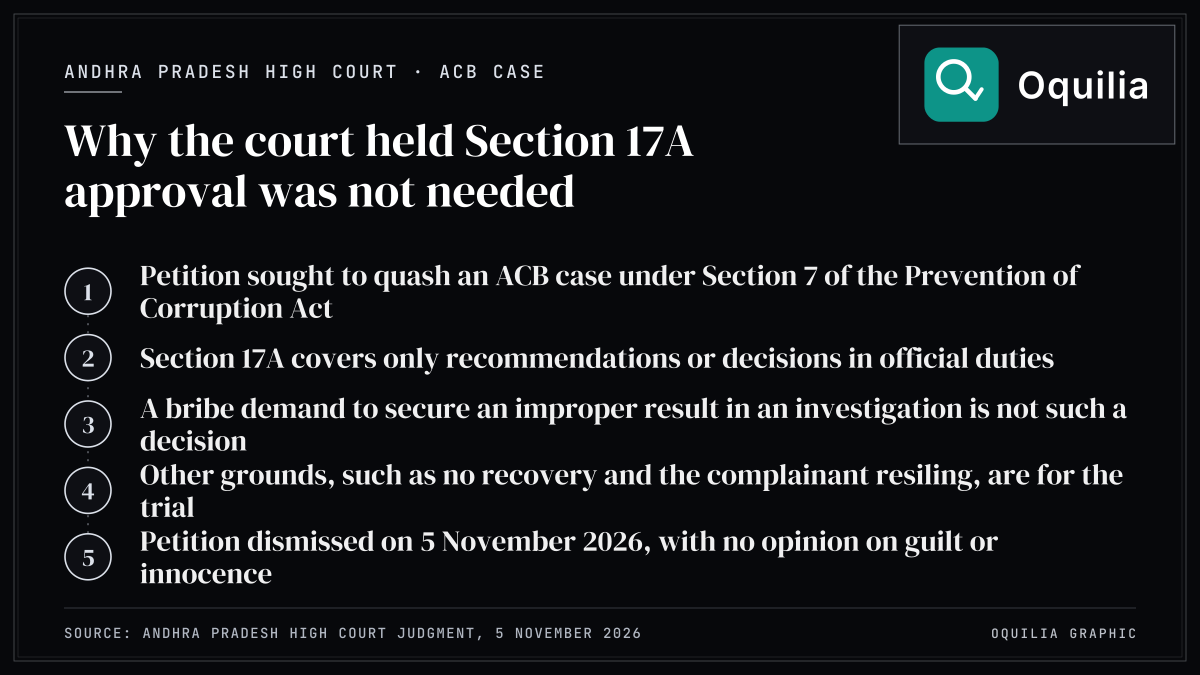
The Andhra Pradesh High Court on 5 November 2026 refused to quash a bribery case registered by the Anti-Corruption Bureau (ACB) against M. Mukteswara Rao, an inspector of police. The court held that prior approval under Section 17A of the Prevention of Corruption Act, 1988 was not needed before the ACB registered the case, because the alleged bribe demand was not a decision taken in his official duties.
What Happened
The case is FIR No. 01/RCO-CIU-ACB/2022 of the ACB's CIU police station in Vijayawada, under Section 7 of the Act, against the inspector and one other accused. According to the order, the ACB alleges that an intermediary approached the inspector on behalf of the accused in a 2022 murder case registered at Thotlavalluru police station, to keep the names of their family members out of that case. The ACB alleges that the inspector demanded a bribe, that certain amounts were paid, and that the intermediary reported to the ACB when he could not meet a further demand.
The inspector argued that the case was registered without the prior approval Section 17A requires, that nothing was recovered from him, that the complainant later resiled from his version in a statement recorded under Section 164 of the CrPC, and that the complainant and the investigating officer were the same person.
The court held that Section 17A covers only offences relatable to a recommendation or decision of a public servant in official duties, and that a demand for a bribe to secure an improper result in an investigation is not such a decision. It held that the other grounds were matters for the trial. It dismissed the petition and said it expressed no opinion on guilt or innocence.
These are allegations, not findings of guilt; the accused are presumed innocent until proven guilty in court, and due process continues.
What It Means
The ruling means a public servant cannot stop a bribery case at the outset only because the agency did not take Section 17A approval, where the charge is a bribe demand rather than an official decision.
Anyone asked for a bribe by a public official can report it to the state anti-corruption bureau; Oquilia's guide lists every state's helpline at https://www.oquilia.com/report-a-bribe.
Source: High Court judgment
Sources & Citations
- High Court judgment — Andhra Pradesh High Court