

SEBI settles Eight Innovate Fund II AIF case for Rs 12.75 lakh
SEBI settled proceedings against Eight Innovate Investment Trust I, its manager and two key personnel for Rs 12.75 lakh over prima facie lapses in sponsor and manager contributions.
Key points
- SEBI settled proceedings against Eight Innovate Investment Trust I, its manager Eight I Advisory LLP and two key personnel through a summary settlement order.
- The applicants paid Rs 12,75,000 after SEBI prima facie observed the manager and sponsor had not contributed pro-rata for the quarters ending June to December 2024.
- The settlement makes no finding of violation, and SEBI keeps the right to reopen the matter if any representation proves untrue or an undertaking is breached.
The Enforcement Action
The Securities and Exchange Board of India (SEBI) has settled proceedings against an alternative investment fund, its manager and two key managerial personnel for Rs 12,75,000, under a summary settlement order in the matter of Eight Innovate Fund II, a scheme of Eight Innovate Investment Trust I. The order, numbered SO/2026-27/PSD/21-24, was digitally signed on 11 November 2026 by Whole Time Members K.V.R. Murty and Kamlesh C. Varshney.
The order covers four summary settlement applications: SS-21/2026 by Eight Innovate Investment Trust I (the "Fund"), SS-22/2026 by Eight I Advisory LLP (the "Manager"), and SS-23/2026 and SS-24/2026 by Vikram Chachra and Venkatramani Vishwanath, whom the order describes as key managerial personnel (KMP).
The issue, according to the order, was the sponsor's and manager's own money in the fund. SEBI "prima facie observed" that the Manager and Sponsor had not contributed to the fund pro-rata to the contributions made by other investors for the quarters ending June 2024 to December 2024.
This is a settlement, not an adjudication. SEBI has not made a final finding that the rules were broken; its observations were prima facie, and the applicants chose to pay the settlement amount to dispose of the proceedings. The applicants are not recorded in the order as having made any public statement on it.
How the Scheme Worked
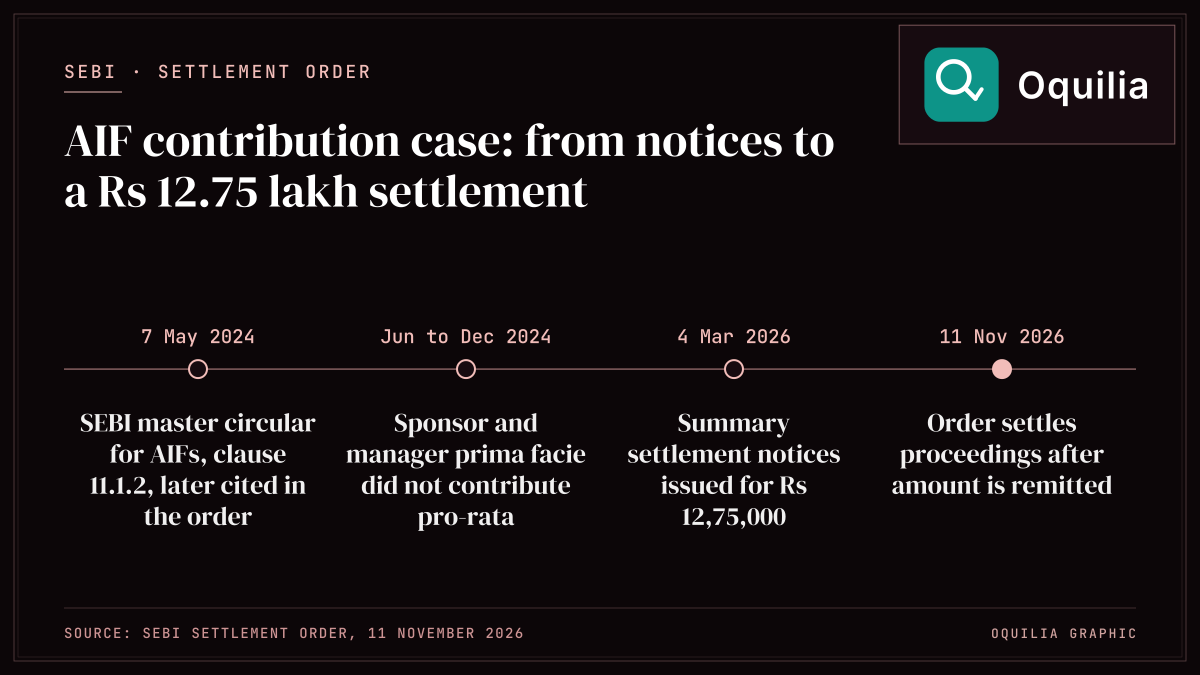
The matter is about a compliance lapse rather than an investor-facing scheme, and the order sets out a short, clear chronology.
First, SEBI examined the Quarterly Activity Reports that Eight Innovate Investment Trust I filed for the period June 2024 to March 2025. These are periodic reports an AIF files with the regulator on its activity. From them, SEBI says it prima facie observed that the Manager and Sponsor had not kept their contribution in step with that of other investors for the quarters ending June 2024 to December 2024. In plain terms, when investors put money in, the sponsor and manager are expected to put in their share alongside them; the order indicates they did not do so in those quarters.
Second, on 04 March 2026, SEBI issued "Notices of Summary Settlement" to the Fund, the Manager and the two KMPs under regulation 16 of the SEBI (Settlement Proceedings) Regulations, 2018. Per the order, the notices told them of the alleged violations and offered to settle and dispose of the enforcement proceedings that might be initiated, on remittance of Rs 12,75,000, payable jointly and severally within 30 calendar days of receipt.
Third, the applicants filed settlement applications and remitted Rs 12,75,000, and SEBI confirmed credit of the amount. The order then settled the specified proceedings with immediate effect.
The order does not say that any investor lost money, and it does not describe any diversion of funds. It records only the prima facie observation on pro-rata contribution and the settlement that followed. Readers should not read more into it than that.
The Law Invoked
The order cites the following provisions, as stated in the document:
- Regulation 10(d) of the SEBI (Alternative Investment Funds) Regulations, 2012, read with clause 11.1.2 of the Master Circular for Alternative Investment Funds dated May 07, 2024. These are the provisions SEBI linked to the sponsor's and manager's contribution to the fund. The Fund was prima facie observed to be in violation of them.
- Regulations 20(1), 20(2) and 20(5) of the AIF Regulations, read with clauses 2(a) and 2(c) of the Code of Conduct in the Fourth Schedule. These set out general obligations and conduct standards for AIFs, their managers and key personnel; SEBI prima facie observed the Manager and the KMPs to be in violation of them as well.
- Section 15JB read with section 19 of the SEBI Act, 1992, and regulation 23 of the Settlement Regulations. Section 15JB empowers SEBI to settle proceedings; the order was passed in exercise of these powers.
- Regulations 16, 25, 28 and 31 of the Settlement Regulations, covering the summary settlement route, publication of the order, and SEBI's right to revive action.
What Happens Next
Under the order, SEBI "shall not initiate any enforcement action against the Applicants for the said violations". That closes the matter, subject to conditions.
The order expressly preserves SEBI's rights under regulations 28 and 31 of the Settlement Regulations to take appropriate action if it finds that any representation the applicants made in the settlement proceedings was untrue, that they breached any condition or undertaking given during the proceedings, or that they failed to pay any difference arising from a discrepancy in working out the settlement terms.
Under regulation 25 of the Settlement Regulations, a copy of the order is sent to the applicants and published on SEBI's website, which is where it now sits. Because the proceedings were settled rather than adjudicated, there is no finding of guilt and no penalty order for any party to appeal.
What It Means
For investors in alternative investment funds, the order is a useful reminder of what the "skin in the game" rules are meant to do. When the sponsor and manager have their own money in the fund in step with investors, their interests stay aligned with those of the people whose capital they manage. SEBI picked up this lapse from the fund's own quarterly filings, which shows the reporting regime working as intended.
AIF investors are typically sophisticated, with high minimum ticket sizes, but they can still do basic checks. Confirm that the fund and its manager are registered with SEBI through the regulator's list of registered intermediaries on its website. Read the private placement memorandum for the sponsor's and manager's commitment, and ask the manager how it is being met as capital is drawn down. Ask for the fund's periodic reports to investors and check that they match what you were told at the outset.
The settlement route also matters for how readers interpret such headlines. A settlement order resolves proceedings by payment; it is not a regulator's verdict that rules were broken. It does, however, become a matter of public record, and investors can weigh it, alongside a manager's wider track record, when choosing a fund.
FAQ
Did SEBI find that the fund broke the rules?
No final finding was made. The order records that SEBI "prima facie observed" violations and that the applicants settled the proceedings by paying Rs 12,75,000. Settlement disposes of the matter without adjudication.
Who were the applicants?
Per the order: Eight Innovate Investment Trust I (SS-21/2026), Eight I Advisory LLP as manager (SS-22/2026), and Vikram Chachra (SS-23/2026) and Venkatramani Vishwanath (SS-24/2026), described in the order as key managerial personnel.
What was the issue in plain terms?
SEBI prima facie observed that the manager and sponsor had not contributed to the fund pro-rata to other investors' contributions for the quarters ending June 2024 to December 2024. SEBI cited regulation 10(d) of the AIF Regulations and clause 11.1.2 of the AIF Master Circular dated May 07, 2024.
Can SEBI reopen the matter?
Yes, in limited cases. The order preserves SEBI's right under regulations 28 and 31 of the Settlement Regulations to act if a representation proves untrue, an undertaking is breached, or a settlement-amount discrepancy goes unpaid.
How can I check whether an AIF is registered?
SEBI publishes lists of registered intermediaries, including alternative investment funds, on its website. Check the fund's registration before investing, and read the private placement memorandum for the sponsor's and manager's own commitment to the fund.
Where can I read the order?
The full settlement order is published on SEBI's website under Enforcement, Orders.
This report is based on the official SEBI settlement order signed on 11 November 2026 in the matter of Eight Innovate Fund II, also available as a PDF on SEBI's website.
This report describes enforcement actions and allegations on the public record, attributed to the officials cited. An order, FIR or chargesheet is not a conviction; parties are presumed innocent until proven guilty.
Named in this report, or spotted an error? Corrections and responses: editor@oquilia.com. We correct errors promptly and record responses from named parties.