

SEBI lets fund managers certify accredited investors, deems non-residents accredited
SEBI has allowed AIF, SIF and portfolio managers to certify investors as accredited themselves, set a Rs 5 crore market-exposure test for individuals and deemed non-residents accredited.
Key points
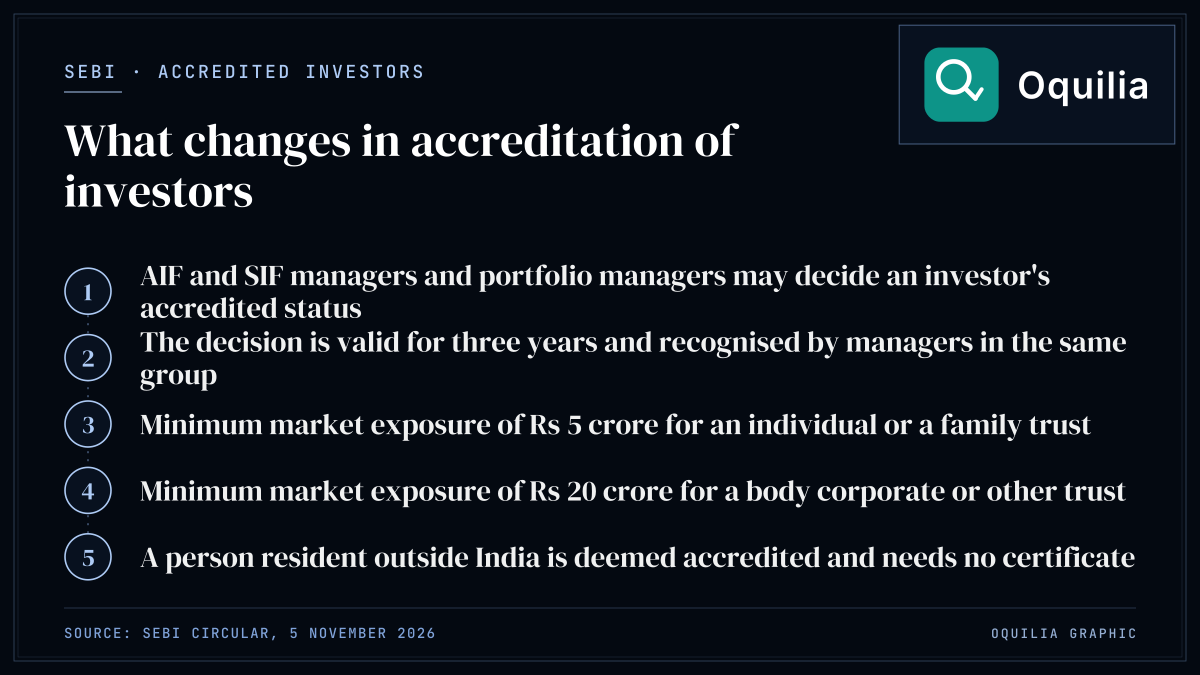
- SEBI's circular of 5 November 2026 lets AIF, SIF and portfolio managers decide an investor's accredited status, valid for three years.
- An individual can qualify with securities market exposure of Rs 5 crore, and a company or non-family trust with Rs 20 crore, SEBI said.
- Persons resident outside India are deemed accredited investors and need no certificate; the circular applies with immediate effect.
The Securities and Exchange Board of India (SEBI) has changed how investors are certified as accredited investors, allowing fund managers to make the decision themselves. Its circular dated 5 November 2026 applies with immediate effect and follows amendments to the Alternative Investment Funds (AIF) Regulations notified on 15 October 2026.
What Happened
SEBI said the manager of an AIF, the asset management company of a Specialized Investment Fund (SIF) or a portfolio manager may now determine and record an investor's accredited status, after checking the eligibility criteria. That decision is valid for three years and is recognised by managers in the same corporate group. Investment advisers and research analysts cannot decide it themselves but may rely on a group manager's decision. The existing route through a recognised accreditation agency continues, and its certificates are also valid for three years.
Investors can qualify on income, net worth or securities market exposure. The minimum exposure is Rs 5 crore for an individual, Hindu Undivided Family, family trust or sole proprietorship, and Rs 20 crore for a body corporate or other trust. Demat holdings, mutual fund folios, unlisted securities in demat form, overseas investments and National Pension System holdings all count. Proof of exposure is an eCAS summary statement from a depository not older than six months, or a chartered accountant's certificate that the threshold was met within the last six months.
A limited liability partnership qualifies only if each partner meets the criteria. A person resident outside India is deemed an accredited investor and needs no certificate, though the fund's duty to check the client and the source of funds still applies.
What It Means
Investors who meet the thresholds can be accredited at onboarding by their fund or portfolio manager rather than through a separate agency. An investor accredited when joining a scheme stays accredited for the rest of that scheme's life, and existing certificates remain valid until they expire.
Managers must keep records for at least five years, separate accreditation from sales, and run a grievance process for investors who dispute a decision. Complaints against SEBI-registered intermediaries can be filed at https://scores.sebi.gov.in.
Source: SEBI circular
Sources & Citations
- SEBI circular — Securities and Exchange Board of India