

SEBI attaches Secunderabad Healthcare accounts over unpaid Rs 2 lakh penalty
SEBI has ordered banks to freeze Secunderabad Healthcare's accounts to recover Rs 2.31 lakh, a penalty for not furnishing information to its investigators, plus interest.
Key points
- SEBI's Recovery Officer in Chennai ordered all banks and post offices to attach Secunderabad Healthcare Limited's accounts on 10 November 2026.
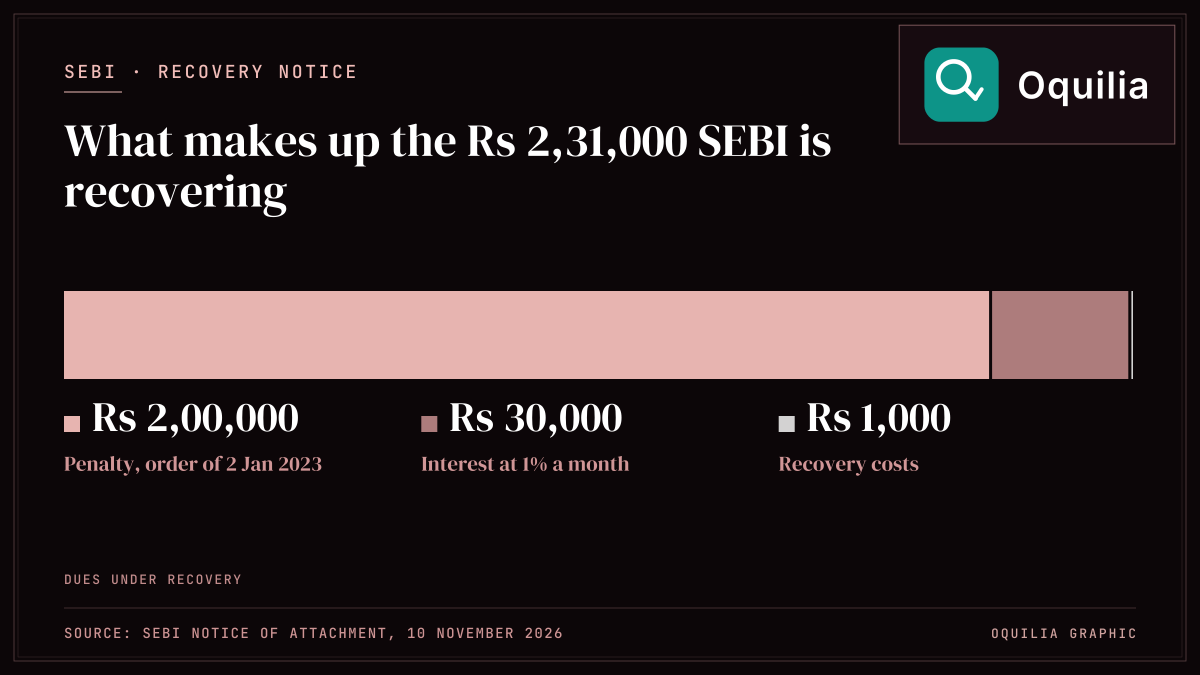
- The dues are Rs 2,31,000, made up of a Rs 2 lakh penalty from a January 2023 order, interest and recovery costs, which the notice says remain unpaid.
- The penalty was for not furnishing information to SEBI's investigators; fraud allegations over a 2010 warrant issue were not established in that order.
The Enforcement Action
The Securities and Exchange Board of India (SEBI) has ordered banks and post offices across the country to attach the accounts of Secunderabad Healthcare Limited, a BSE-listed company, to recover an unpaid penalty. The notice of attachment dated 10 November 2026 was issued by the Recovery Officer at SEBI's Southern Regional Office in Chennai under Attachment Proceeding No. 15873 of 2026 and Recovery Certificate No. 7734 of 2024.
The sum SEBI is seeking is Rs 2,31,000. According to the notice, that is made up of a Rs 2,00,000 penalty imposed by a SEBI Adjudicating Officer by order dated 2 January 2023, interest of Rs 30,000 for January 2023 to March 2024 at 1% a month, and Rs 1,000 in recovery costs. The recovery certificate and a notice of demand were both dated 15 March 2024.
The notice states that "no amount has been paid by the defaulter" and that SEBI has reason to believe that recovery "would in consequence be delayed or obstructed" unless the accounts are frozen. It directs that no debits be allowed from the company's accounts, including lockers, to the extent of the dues, until further orders. Credits into the accounts may still be allowed.
The penalty behind the notice was not imposed for market manipulation. In the January 2023 order, SEBI's Adjudicating Officer found that the company had not furnished information sought during an investigation, and penalised it for that alone. Wider allegations against the company and seven other entities were not established. The company has not publicly responded to the attachment notice.
How the Scheme Worked
The matter goes back to a preferential allotment in 2010. According to the adjudication order dated 2 January 2023, Secunderabad Healthcare allotted 8,00,00,000 warrants on 14 October 2010 to 27 non-promoter entities. Each warrant was convertible into one equity share of Rs 10 at a premium of Rs 8.60, an issue price of Rs 18.60. Allottees were to pay at least 25% before allotment and the balance within 18 months. The warrants were converted in two tranches, on 2 March 2011 and 31 March 2012.
SEBI investigated trading in the company's shares for the period 1 November 2011 to 15 January 2015. Its show-cause notice of 31 December 2019, as summarised in the order, alleged that seven of the allottees had received shares without paying the full price. On SEBI's reading of the bank records at the time, the shortfall ran from Rs 2,95,000 for one allottee to more than Rs 5 crore each for two others. The notice also alleged that the company had sent money back to some allottees after receiving it.
On that basis, the show-cause notice alleged that the company had given "a public impression of capital infusion" while allotting shares without full payment. It further alleged that the allottees, which it said were connected to the company through common directors, had benefited at the cost of other shareholders. It alleged that two allottees had made Rs 10.57 crore by selling the shares.
Those allegations were tested and not upheld. The company and the seven allottees replied that the full consideration had been paid before the due dates. They pointed to the auditors' notes in the company's annual reports and to its April 2012 disclosure to BSE. The Adjudicating Officer examined the bank statements they produced and found that the required sums "have indeed been received" in tranches between August 2010 and March 2012. The order held that the allegations of non-payment and of fraud on other investors "do not stand established".
What remained was the investigation itself. The order records that SEBI emailed the company in August and September 2018 and issued summonses on 21 September, 1 October and 23 October 2018, seeking details of funds received from all 27 allottees. The first summons was served on 27 September 2018. According to the order, the company did not supply the information then, and handed it over only after SEBI issued directions against it on 30 April 2021. The Adjudicating Officer described this as a "lackadaisical attitude" towards the regulator and held that it had hampered the investigation.
The Law Invoked
The penalty was imposed under Section 15A(a) of the SEBI Act, 1992, for breaching Sections 11C(2) and 11C(3). Section 11C(2) requires company officers and anyone associated with the securities market to preserve and produce records to SEBI's investigating authority. Section 11C(3) allows the investigating authority to require any such person to furnish information or documents it considers necessary. Section 15A(a), as quoted in the order, sets a penalty of at least Rs 1 lakh, which may rise by Rs 1 lakh for each day the failure continues, up to Rs 1 crore. The order was passed under Section 15-I of the SEBI Act and Rule 5 of the 1995 adjudication rules, and it weighed the factors in Section 15J.
The show-cause notice had also invoked Section 12A(a), (b) and (c) of the SEBI Act, Regulations 3(a) to (d) and 4(1) of the PFUTP Regulations, 2003, and Regulations 77(1) and 77(3) of the ICDR Regulations, 2009. Regulation 77(3) requires the balance 75% of a warrant's price to be paid when it is converted into shares. The order disposed of the proceedings on all of these charges.
The attachment notice relies on Sections 28A(1) and 11(2)(ia) of the SEBI Act, read with Section 226 and the Second Schedule to the Income-tax Act, 1961. Section 28A lets SEBI recover unpaid penalties using the tax-recovery procedures in that Schedule.
What Happens Next
Under the notice, every bank and post office must, within 15 days of service, send SEBI details of any accounts and lockers the company holds. They must also send a year of statements, confirmation that the accounts are attached, and details of any loans and the assets charged against them. A bank that does not reply within 15 days is presumed to hold no account or balance for the company. Any new account the company opens must also be attached at once and reported to SEBI.
In recovery proceedings of this kind, attachment usually comes before a remittance order, under which banks are told to pay the attached balances to SEBI. If bank and demat balances fall short, the Recovery Officer can go further and prohibit dealings in the defaulter's movable and immovable property. The notice also directs the company not to collect or withdraw the money held in the attached accounts.
An Adjudicating Officer's order can be appealed to the Securities Appellate Tribunal. The attachment notice does not mention any appeal or stay. It records only that the dues remain unpaid.
What It Means
For most investors, the main point is what this case does not show. SEBI's own adjudication found that the allottees had paid in full for their shares. The fraud allegations were not established. The penalty, and now the attachment, are about the company failing to answer the regulator's questions during an investigation and then not paying the penalty that followed. It is worth reading the underlying order before drawing conclusions about a stock.
The case also shows that SEBI treats cooperation with its investigations as a legal duty in its own right. The order quotes earlier tribunal rulings holding that ignoring summonses "cannot be viewed lightly". A small unpaid penalty can lead to frozen bank accounts more than three years later, and dues keep earning interest at 1% a month until they are paid.
Shareholders of any listed company can check its enforcement record. Search the company's name in the Enforcement section of sebi.gov.in, where orders and recovery proceedings are published, and check the company's disclosures on the stock exchange.
FAQ
What exactly did SEBI order on 10 November 2026?
SEBI's Recovery Officer in Chennai directed all banks and post offices in India to attach every account and locker held by Secunderabad Healthcare Limited, singly or jointly. No debits are allowed up to Rs 2,31,000, the dues under Recovery Certificate No. 7734 of 2024, until further orders. Banks must report account details, statements and any loans within 15 days of service.
Did SEBI find that Secunderabad Healthcare defrauded investors?
No. The adjudication order of 2 January 2023 held that the allegations of shares issued without full payment, and of fraud on other shareholders, did not stand established, based on bank records showing full payment. The Rs 2 lakh penalty was imposed only for failing to furnish information sought by SEBI's investigating authority under Sections 11C(2) and 11C(3) of the SEBI Act.
Can the penalty or the attachment be challenged?
An Adjudicating Officer's order under the SEBI Act is appealable to the Securities Appellate Tribunal. The attachment notice does not refer to any appeal or stay, and states that no amount has been paid. Attachment ends once the dues, with interest and costs, are recovered or the Recovery Officer orders otherwise.
What does this mean for shareholders of the company?
The notice is aimed at the company's bank and post office accounts. It does not touch shares held by investors. It does show that the company has not paid a regulatory penalty imposed almost four years ago. Shareholders may want to follow the company's stock exchange disclosures for any statement on the dues or on the recovery proceedings.
Where can I read the official documents?
Both are on SEBI's website. The attachment notice is under Enforcement, Recovery Proceedings, dated 10 November 2026. The adjudication order is under Enforcement, Orders, dated 2 January 2023, titled as an order in respect of Secunderabad Healthcare Ltd. and seven others. Both are linked in this report.
This report is based on SEBI's official notice of attachment dated 10 November 2026 and the SEBI adjudication order dated 2 January 2023, both published by the Securities and Exchange Board of India.
This report describes enforcement actions and allegations on the public record, attributed to the officials cited. An order, FIR or chargesheet is not a conviction; parties are presumed innocent until proven guilty.
Named in this report, or spotted an error? Corrections and responses: editor@oquilia.com. We correct errors promptly and record responses from named parties.