

Pimco and Apollo sound alarm on $2 trillion AI debt binge
Pimco's chief says an AI downturn is coming even as Meta, Oracle and Microsoft borrow billions. Here is why India's data-centre push should pay attention.
Key points
- Pimco chief executive Emmanuel Roman warned in Hong Kong on 3 November that an AI market downturn is coming.
- Roman estimates the AI buildout could need $2 trillion of financing over five years, as Meta, Oracle, Alphabet and Microsoft sell bonds.
- A tighter global credit market or US rate shock could raise funding costs for India's data-centre projects and hit the rupee.
The News
Two of the largest names in global credit have warned that the debt-funded artificial intelligence boom carries real risk, even as big technology companies continue to borrow at record pace. Speaking at the 2026 Global Financial Leaders' Investment Summit in Hong Kong on 3 November, Pimco chief executive Emmanuel Roman said a downturn in the AI market was coming, after which things would "break". He has estimated that the AI buildout could generate $2 trillion in financing needs over the next five years.
Apollo Global Management president Jim Zelter struck a similar note with analysts, saying computing demand will keep rising but that it remains unclear "how pricing and economics will evolve".
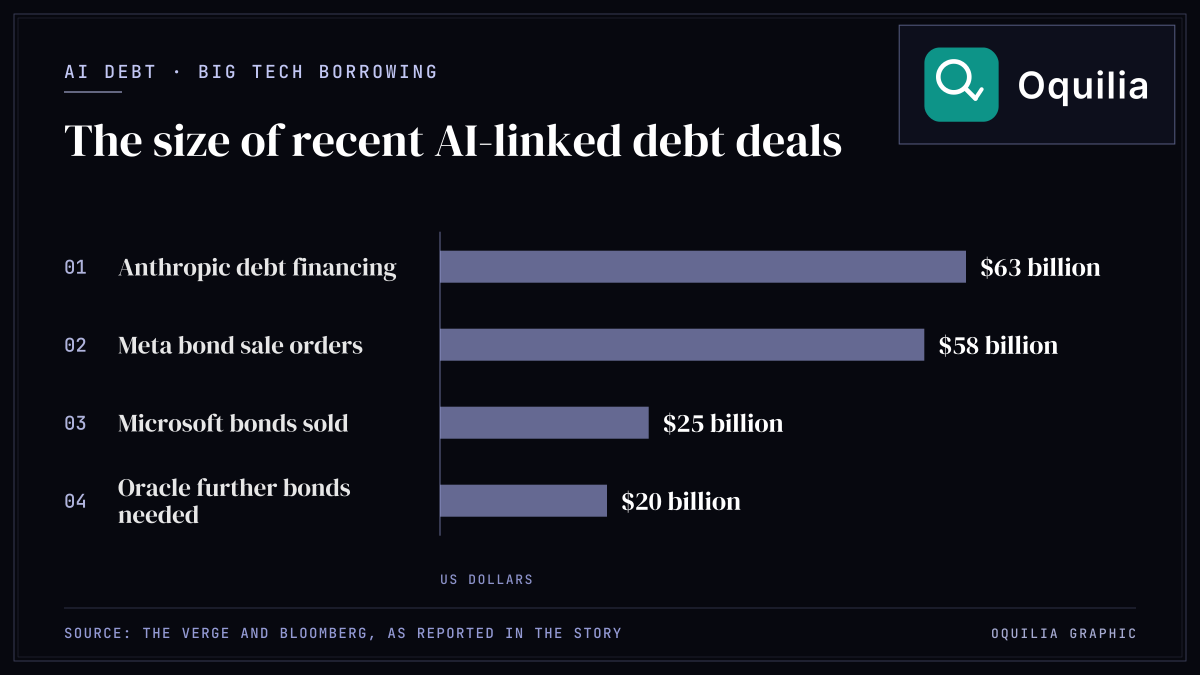
The caution sits beside heavy borrowing. Meta drew $58 billion in orders for a bond sale expected to raise $15 billion to $20 billion, according to Bloomberg. Oracle said it would need another $20 billion in bonds, Alphabet is selling €6 billion (about $6.7 billion) of debt, and Microsoft recently sold $25 billion of bonds, its first such issue in a decade. The Verge also reported that banks competed to finance $63 billion of debt for Anthropic.
Why It Matters
Pimco's voice carries weight because it has been one of the AI trade's biggest financiers. The firm took part in the first chip-backed financing for CoreWeave in 2023, booked about $2 billion in paper gains on $29 billion of Meta bonds last year, and bought $4 billion of SpaceX bonds last month. When a lender that deep in the trade talks about a correction, bond markets listen.
The scale is the other concern. Roman's $2 trillion estimate compares with a US bond market of roughly $12 trillion, as cited by The Verge. The closest parallel is the telecom build-out of the late 1990s, when carriers borrowed heavily to lay fibre ahead of demand and many defaulted after 2001. The difference this time is that order books, such as Meta's, remain oversubscribed several times over, so investors are still buying. Roman named US rate hikes, war or a eurozone crisis as possible triggers for a reversal.
Indian Angle
India is building its own AI infrastructure on borrowed and foreign money. Google has announced a $15 billion AI hub in Visakhapatnam with AdaniConneX and Airtel, and domestic groups are expanding data-centre capacity. If global lenders turn cautious, the cost of funding such projects, much of it raised in dollars or from foreign investors, could rise, and timelines could slip.
The government's IndiaAI Mission, with an outlay of Rs 10,372 crore, subsidises GPU access for Indian startups and researchers. A tighter credit market abroad would not touch that budget directly, but it could raise the price of the compute that Indian model builders rent from global cloud providers.
For Indian investors, the triggers Roman listed matter more than the AI story itself. A US rate shock tends to pull foreign portfolio money out of emerging markets and weaken the rupee, which hits Indian equities and debt funds regardless of AI exposure. Indian IT services firms that earn revenue from US enterprise AI projects would also feel any slowdown in spending.
FAQ
Who issued the warnings?
Pimco chief executive Emmanuel Roman spoke at the Global Financial Leaders' Investment Summit in Hong Kong on 3 November 2026. Apollo Global Management president Jim Zelter raised similar uncertainties with analysts. Both firms have been large financiers of AI-linked debt, which is why their caution drew attention.
How much debt is the AI buildout expected to need?
Roman has estimated about $2 trillion in financing needs over the next five years. Recent deals include Meta's planned $15 billion to $20 billion bond sale, Oracle's stated need for another $20 billion, Alphabet's €6 billion offering and Microsoft's $25 billion sale.
Does this mean an AI crash is imminent?
No one has said that. Heavy oversubscription for Meta's bonds suggests investors are still keen. Roman pointed to specific triggers, namely US rate hikes, war or a eurozone crisis, that could turn sentiment, but he gave no timeline.
What should Indian investors watch?
Watch US interest-rate decisions, foreign portfolio flows and the rupee, since these are the channels through which a global credit shock would reach Indian markets. Also track funding announcements for Indian data-centre projects.
This story was reported by The Verge. Read the full original coverage at The Verge.