

GSTN: e-invoicing for reverse-charge self-invoices mandatory from 1 January 2027
The GST Network said e-invoicing will apply to reverse-charge self-invoices on supplies from unregistered persons and on imported services from 1 January 2027, with voluntary use from 15 December 2026.
Key points
- The GST Network said e-invoicing is extended to reverse-charge self-invoices for supplies from unregistered persons and for imported services.
- Mandatory e-invoicing for these two supply types starts on 1 January 2027; voluntary IRN generation is allowed from 15 December 2026.
- Businesses must update and test billing systems before 1 January 2027, using the IRP sandboxes for testing.
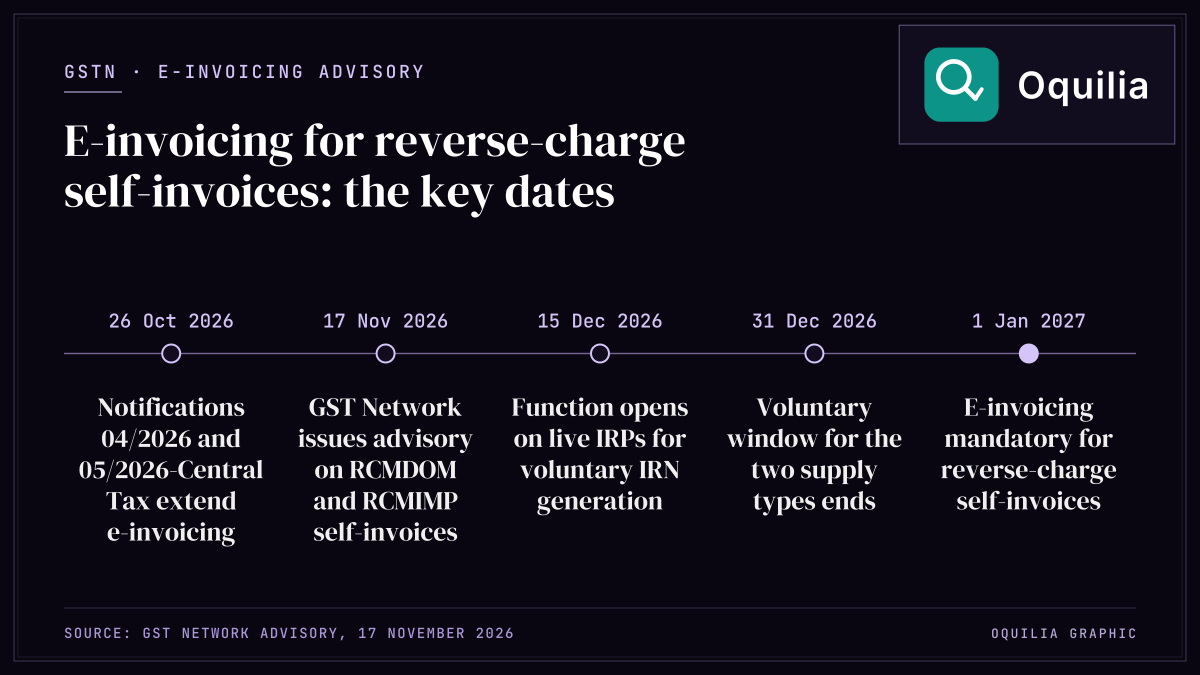
Taxpayers who pay GST under the reverse charge mechanism on supplies from unregistered persons, or on imported services, must issue e-invoices for these self-invoices from 1 January 2027, the GST Network said in an advisory dated 17 November 2026. The facility opens on the live e-invoice systems from 15 December 2026 for voluntary early use.
What Happened
Under the reverse charge mechanism (RCM), the buyer, not the seller, pays the GST and issues an invoice to itself. The GST Network said the Government, through Notification No. 04/2026-Central Tax dated 26 October 2026, has extended e-invoicing to two such categories: domestic supplies received from unregistered persons (called RCMDOM) and import of services (called RCMIMP). Matching amendments to the CGST Rules and the e-invoice schema were notified through Notification No. 05/2026-Central Tax of the same date.
The advisory says the RCMDOM and RCMIMP functions are already available in the sandbox (test) environments of all six authorised Invoice Registration Portals (IRPs), which issue the Invoice Reference Number (IRN) for each e-invoice. The function is proposed to be enabled in the production environments of the IRPs from 15 December 2026. From 15 December to 31 December 2026, eligible taxpayers may voluntarily generate an IRN for these two supply types.
For RCMDOM and RCMIMP, the system will accept only documents dated 15 December 2026 or later for IRN generation in production. The GST Network said mandatory e-invoicing for these supply types takes effect from 1 January 2027 only.
What It Means
Businesses covered by e-invoicing that buy from unregistered suppliers or import services will need their accounting and billing systems to generate e-invoices for these self-invoices from 1 January 2027. The GST Network has asked taxpayers, GST Suvidha Providers, application service providers and ERP providers to finish development, integration and testing well before that date.
Testing should be done in the sandbox with sample data; the production environment is to be used only for genuine transactions. Technical specifications and validation rules are on the NIC e-Invoice API Developer Portal at https://einv-apisandbox.nic.in/. For questions on applicability, scope and exemptions, the advisory points taxpayers to the two notifications and related circulars, and to the e-invoice portal at https://einvoice.gst.gov.in.
Source: GST portal update
Sources & Citations
- GST portal update — GST Network