

Delhi High Court rejects would-be buyer's challenge to Bank of Baroda auction, imposes costs
The Delhi High Court held that a person who only intended to bid has no standing to challenge a bank recovery auction, and dismissed his petition with costs of Rs 1 lakh.
Key points
- The Delhi High Court dismissed a petition seeking to set aside a recovery auction held for Bank of Baroda on 21 January 2025.
- The court held the petitioner, who only claimed to be an intending purchaser, was not an aggrieved person, and imposed costs of Rs 1 lakh.
- The ruling means only those whose interests are affected, not would-be bidders, can challenge a bank recovery auction.
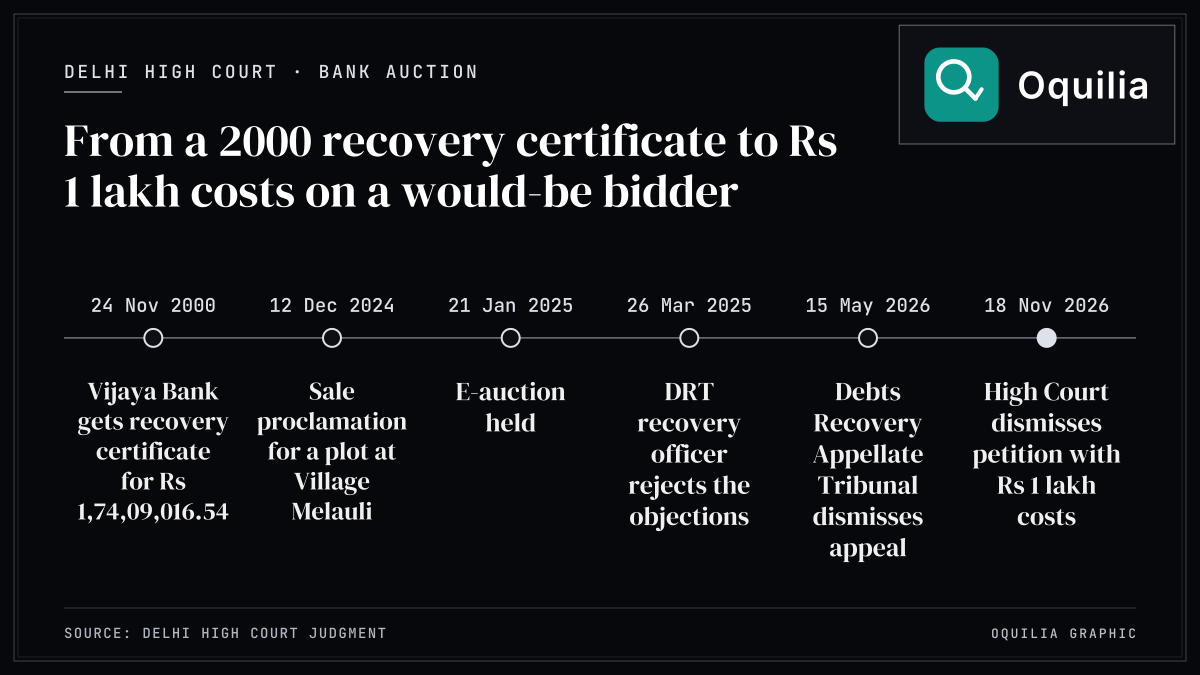
The Delhi High Court on 18 November 2026 dismissed a petition that sought to set aside a recovery auction held for Bank of Baroda, holding that a person who merely intended to take part in an auction has no right to challenge it. The court imposed costs of Rs 1 lakh on the petitioner.
What Happened
According to the judgment, Vijaya Bank, now part of Bank of Baroda, obtained a recovery certificate dated 24 November 2000 for Rs 1,74,09,016.54 in a case against Rockland Leasing Limited and others before the Debts Recovery Tribunal (DRT). A plot of land at Village Melauli was put up for sale under a proclamation dated 12 December 2024, and the e-auction was held on 21 January 2025.
The petitioner, who said he was an intending purchaser, filed three objections to the sale proclamation, alleging irregularities such as parts of the land having been sold earlier. The DRT's recovery officer rejected the objections on 26 March 2025, the DRT refused to stay that order on 20 August 2025, and the Debts Recovery Appellate Tribunal dismissed his appeal on 15 May 2026.
The High Court held that the petitioner was not the borrower, owner or tenant, had no part in the loan and did not take part in the auction, so he was not an aggrieved person. It said that the mere chance that a higher price might have been obtained had he bid was an imaginary right. The court said that allowing such challenges would let anyone delay auctions, which would go against the scheme of the Recovery of Debts and Bankruptcy Act. It held that he had abused the process of law and ordered the costs to be paid within three weeks, Rs 50,000 of it to the Army Welfare War Widows Fund.
What It Means
The ruling makes clear that only a person whose own interests are affected, such as the borrower or someone with a stake in the property, can challenge a bank's recovery auction. For bidders who buy property at such auctions, it limits challenges from outsiders that could delay the sale.
Source: High Court judgment
Sources & Citations
- High Court judgment — Delhi High Court