

Apple bets on AI upgrades as iPhone hits $57.6bn September record
Apple logged its best fiscal year while spending a fraction of rivals on AI infrastructure. Here is what its toll-booth AI strategy means for India.
Key points
- Apple reported its best fiscal year for revenue and earnings per share, with executives pitching AI as a reason to upgrade.
- iPhone revenue rose 17.5% to $57.6 billion in the September quarter, while capital spending was just $2.2 billion.
- Indian AI app makers face App Store fee choices, and Siri's AI upgrade does not yet support any Indian language.
The News
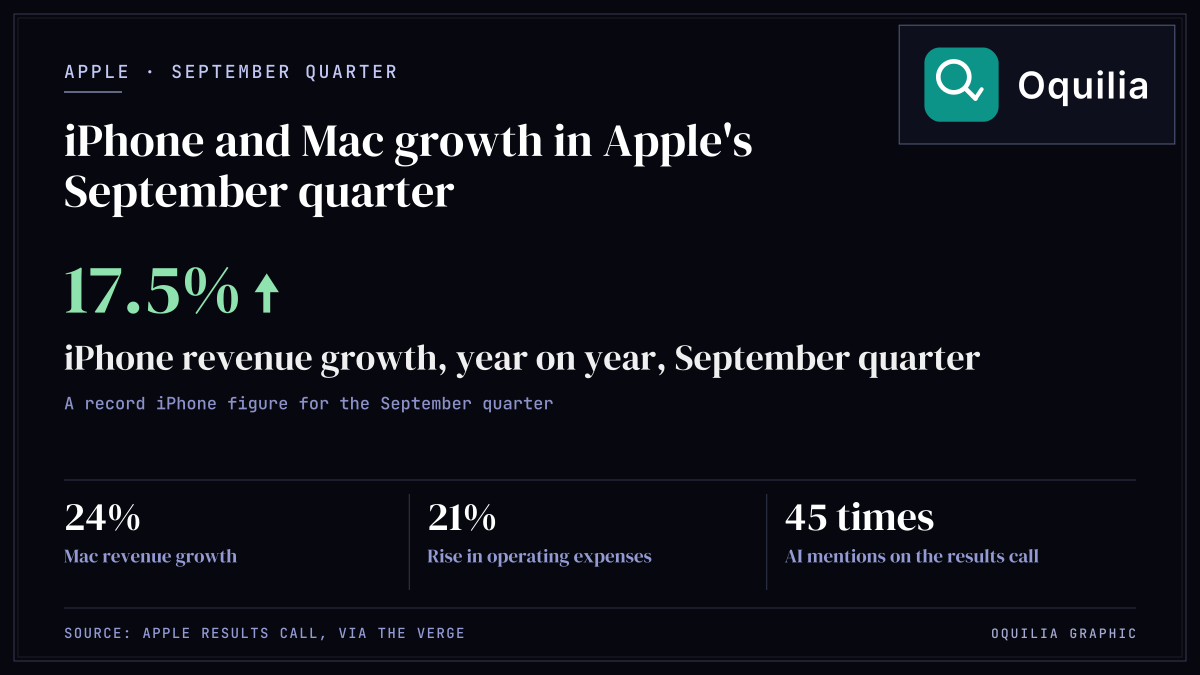
Apple has closed its strongest fiscal year on record for both revenue and earnings per share, and its leadership used the latest results call to make the case that artificial intelligence will keep the upgrade cycle turning. In the September quarter, iPhone revenue grew 17.5% year on year to $57.6 billion, a record for that quarter, while Mac revenue jumped 24% to $10.8 billion, the best Mac figure in four years.
The shares still slipped in premarket trading on Tuesday. Apple cautioned that rising memory costs would weigh on profit margins during the holiday quarter.
AI came up 45 times on the call, a record count according to research platform AlphaSense. John Ternus, speaking on his first earnings call as chief executive, said: "We see tremendous opportunity in AI." Chief financial officer Kevan Parekh argued that AI gives buyers a reason to upgrade or switch to Apple devices, and pointed to openings across first-party features, third-party apps and partnerships.
Why It Matters
The striking number is not revenue but spending. Apple's capital expenditure last quarter came to $2.2 billion, against $77.3 billion at Amazon and $51.4 billion at Alphabet. The figures are companywide, but the gap shows two different bets. Rivals are building the infrastructure; Apple is positioning itself as the front door through which more than 2.5 billion active devices reach AI, including models made by others. Its revamped Siri uses models developed with Google's Gemini technology, and operating expenses rose 21% to $19.2 billion as research spending climbed.
This is a familiar playbook. When Apple opened the App Store in 2008, it did not need to write most of the software people wanted; it collected a share of what developers earned. The same logic now applies to AI: sell the hardware, take a cut of AI app subscriptions, and later charge for heavier use of Apple's own server-based features. Ternus said those features will carry usage limits, with expanded access to be sold in the future. The risk is visible too: OpenAI has started steering subscribers to pay on its website rather than through the App Store, according to The Wall Street Journal.
Indian Angle
For Indian AI app makers, Apple's toll-booth model is a direct cost question. Startups selling subscriptions to Indian iPhone users face the same choice OpenAI is making: accept App Store fees or push customers to web payments. With Indian consumers highly price-sensitive and many subscriptions priced in low hundreds of rupees, every percentage point of commission matters more here than in dollar markets.
There is also a language gap. Siri's AI upgrade launched in beta for US English in September and was extended in October to French, Japanese, Korean, Portuguese and Spanish. Neither Hindi nor any other Indian language is on that list yet, which leaves room for homegrown players such as Sarvam AI and Krutrim, which are building models for Indian languages, to serve users Apple's assistant does not yet reach.
The local-AI pitch may matter most for Indian enterprises. Apple cited Gap running loss-prevention AI on Mac Mini machines across hundreds of stores, avoiding per-request cloud token charges. For Indian firms paying cloud and model bills in dollars, a one-off hardware purchase that keeps data on-premises can be attractive, both to shield budgets from rupee depreciation and to simplify obligations under the Digital Personal Data Protection Act, 2023.
FAQ
How strong were Apple's latest quarterly numbers?
iPhone revenue rose 17.5% to $57.6 billion and Mac revenue climbed 24% to $10.8 billion. It was Apple's best fiscal year ever for revenue and earnings per share, though memory costs will pressure holiday-quarter margins.
Why is Apple spending so much less than rivals on AI infrastructure?
Apple combines on-device processing, its own servers and outside models rather than building vast data-centre capacity, so its quarterly capital spend stays far below Amazon's and Alphabet's.
Is Siri's AI upgrade available in Indian languages?
Not yet. It launched in beta for US English in September and expanded in October to French, Japanese, Korean, Portuguese and Spanish. Apple has not announced a timeline for Hindi or other Indian languages.
Will Apple charge extra for its AI features?
Ternus said server-based features, including Siri AI and intelligent photo editing, will have usage limits, and customers wanting more capacity will be able to buy expanded access in future. Pricing has not been announced.
This story was reported by The Verge. Read the full original coverage at The Verge.