

Choosing a home loan is one of the most consequential financial decisions an Indian household makes, and the difference of even 15-20 basis points can translate into lakhs of rupees over a 20-year tenure. With the RBI having cut the repo rate by 125 basis points through 2025 and held it at 5.25% in February 2026, all three major lenders — SBI, HDFC Bank, and ICICI Bank — have revised their rates. Here is a detailed comparison as of April 2026.
Interest Rate Comparison
SBI currently offers its home loan starting at 8.25% per annum under the EBLR regime, making it the cheapest among the three for salaried applicants with a CIBIL score above 750. The rate is linked to the RBI repo rate (5.25%) plus a spread, with the spread varying based on loan amount and borrower profile. For loans above Rs 75 lakh, the rate increases to 8.40%.
HDFC Bank's home loan starts at 8.40% for salaried borrowers. While marginally higher than SBI, HDFC Bank offers faster processing times — typically 5-7 working days versus 10-14 days at SBI — and has a wider network of builder tie-ups that can simplify documentation. ICICI Bank sits at 8.45% for its base slab, but offers aggressive discounts for existing savings and salary account holders, potentially bringing the effective rate down to 8.30%.
Processing Fees and Hidden Charges
SBI charges a processing fee of 0.35% of the loan amount, capped at Rs 10,000. This is often waived during festive season campaigns. HDFC Bank charges 0.50% with no upper cap, which makes it significantly more expensive for large-ticket loans — a Rs 1 crore loan attracts a processing fee of Rs 50,000. ICICI Bank charges 0.50% but frequently runs promotional offers that reduce this to Rs 5,000 or waive it entirely for digital applications submitted through its app.
Prepayment charges deserve attention. Under RBI regulations, no bank can levy prepayment or foreclosure charges on floating-rate home loans. However, some banks impose documentation or administrative fees for part-prepayment requests made at branches. SBI has the cleanest policy here, with zero charges and a fully digital part-prepayment facility through YONO. Both HDFC Bank and ICICI Bank offer online prepayment, though the process involves additional verification steps.
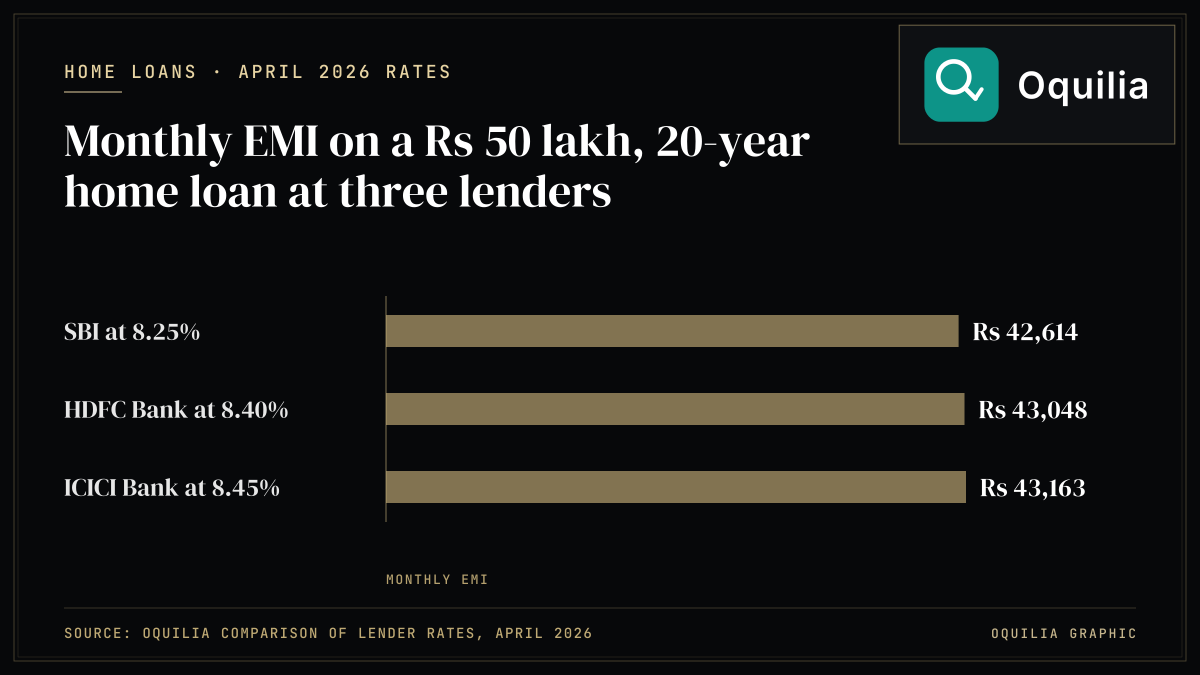
EMI Comparison for a Rs 50 Lakh Loan
For a standard Rs 50 lakh home loan over 20 years, the monthly EMI at SBI's 8.25% comes to Rs 42,603. At HDFC Bank's 8.40%, the EMI rises to Rs 43,075 — a difference of Rs 472 per month or Rs 5,664 per year. At ICICI Bank's base rate of 8.45%, the EMI is Rs 43,233. Over the full 20-year tenure, the total interest paid at SBI would be approximately Rs 52.25 lakh, compared to Rs 53.38 lakh at HDFC Bank and Rs 53.76 lakh at ICICI Bank. The gap between the cheapest and most expensive option is Rs 1.51 lakh in total interest — a meaningful amount that justifies careful comparison shopping.
Which Bank Should You Pick?
On these rate cards, SBI's starting rate is the lowest of the three, and its processing takes longer. HDFC Bank's processing is the quickest, and it has the most builder tie-ups. ICICI Bank offers rate discounts to some existing account holders. Oquilia does not recommend any lender; the figures are for comparison.
Regardless of which lender you choose, ensure your CIBIL score is above 750 before applying, negotiate the spread aggressively, and use an EMI calculator to model different scenarios. A difference that looks small on a monthly basis compounds into a substantial saving over two decades.
Source
SBI Home Loans portal; HDFC Bank home loan rate card; ICICI Bank mortgage rate sheet, April 2026